




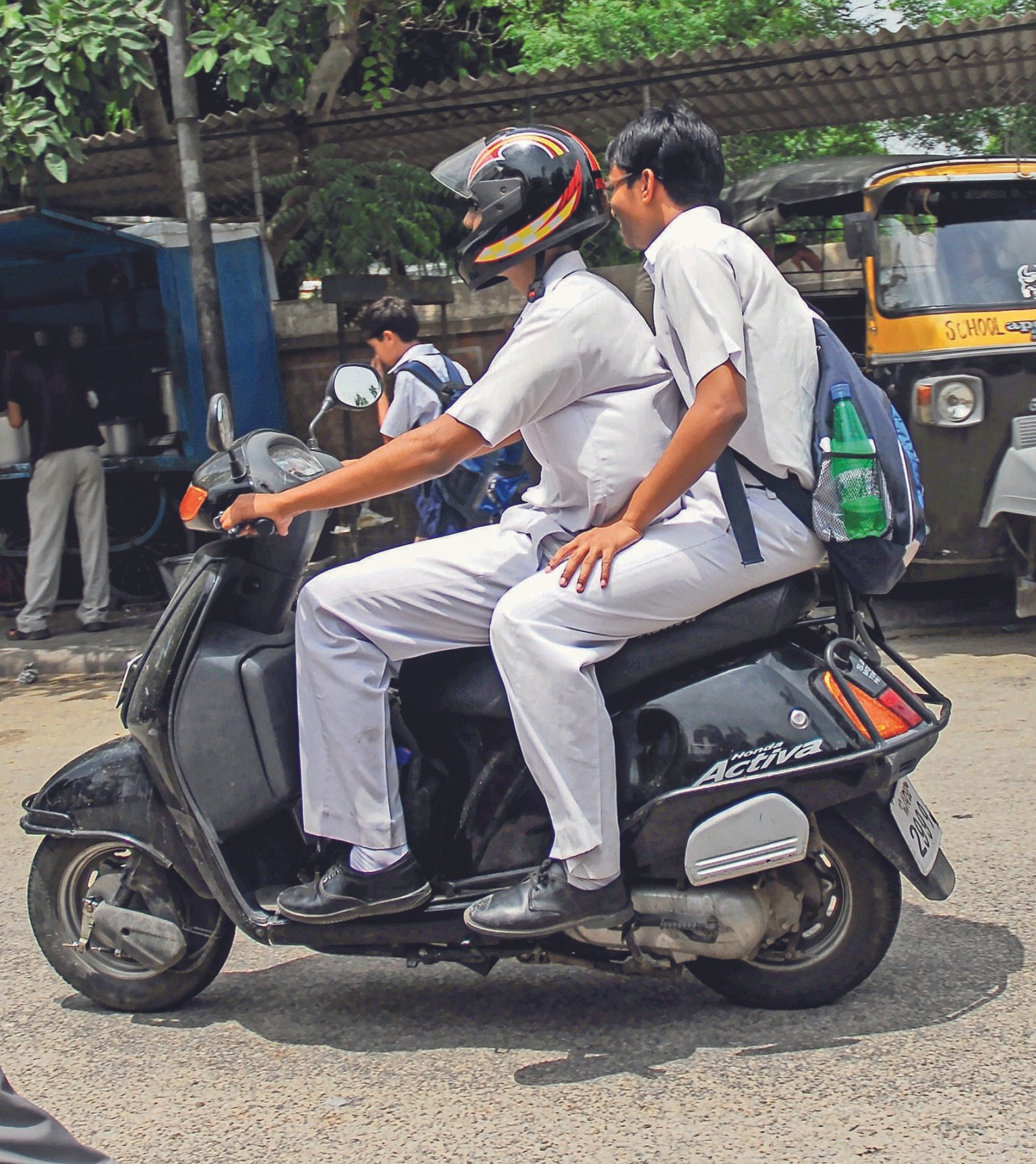
A recent case at the National Institute of Mental Health and Neurosciences (NIMHANS) involved a Class 10 student preparing for his board examinations who stepped out for a break from his studies to spend some time with friends.
An hour later, he was brought to the hospital injured and unconscious after falling off a motorcycle. His parents were unaware that he had been riding a two-wheeler with his friends. While his mother worried about how the accident would affect his board examinations, the family was confronted with a far more devastating reality: the head injury had caused permanent damage to a part of his brain, and the boy might never be able to study again.
This is the hidden cost of underage driving, a risk that often goes unnoticed until a child is wheeled into an emergency room.
Data from NIMHANS shows that the institute recorded 29,631 traumatic brain injury cases between January 2023 and December 2025, of which 8,026 case records have been analysed as part of an ongoing research project on
The injuries are often far more serious than parents anticipate. “The common head injuries are skull and facial bone fractures and bleeding inside and over the brain. Two-thirds of teenage rides have brain injuries requiring admission or surgery,” he said.
What makes the situation particularly alarming is that many of these crashes are not even caused by collisions with other vehicles. “Two-thirds of the teenage riders skid and fall rather than collide with other vehicles. Moreover, it was also found that these riders crashed into stationary objects like poles, road medians, or walls. Some children also mentioned that they accelerated accidentally instead of applying the brakes. This indicates that the children do not have control over the vehicle, and they have poor judgment of speed and distance,” Dr Shukla explained.
The consequences can extend well beyond hospitalisation and surgery, with serious head injuries potentially causing long-term changes in mood, memory, speech, behaviour and personality. These effects can significantly impair a child’s academic performance, affect college admissions and limit future employment opportunities. Such injuries can also push families into catastrophic financial expenditure.
While parental supervision is important, Dr Shukla cautioned against viewing the problem merely as parental negligence. Peer influence and the desire to appear grown-up play a significant role. “Puberty hits during the teenage years, and it does not hit at the same time in all children. The physical changes precede brain maturity. Children feel like adults because of their bodily appearance, but the brain is still not mature enough to make decisions. Judgment comes after 20 years of age.”
He added, “Some parents feel pride in their underage child riding a two-wheeler, which puts pressure on other parents to encourage their children to start riding at an earlier age.
However, parents should realize that there is a particular age for giving specific things to their children. The vehicles are not toys and cannot be handed over to the children.”
The law is clear
Under the Motor Vehicles Act, 1988, individuals aged 16 and above can obtain a learner’s licence to ride a gearless motorcycle with an engine capacity not exceeding 50cc, subject to written consent from a parent or guardian. However, as most modern scooters exceed this engine capacity, they do not qualify under this provision. Low-speed electric scooters with a motor power of up to 250 watts and a maximum speed of 25 kmph are exempt from registration and licencing requirements. Those aged 18 and above are eligible to apply for a driving licence to ride geared motorcycles and other motor vehicles.
DRIVING LICENCE: WHAT THE LAW SAYS
Licence mandatory: No person can drive a motor vehicle in a public place without a valid driving licence issued by the Licencing Authority.
Below 18 years: Learners below 18 can obtain a learner’s licence only for a motorcycle without gears, with written consent from a parent or guardian.
18 years and above: Eligible to apply for a driving licence to operate motor vehicles other than transport vehicles.
20 years and above: Eligible to apply for a licence to drive a transport vehicle.
Licencing authorities: The Joint Commissioners, Deputy Commissioners and Regional Transport Officers (RTOs) are the designated Licencing Authorities.