




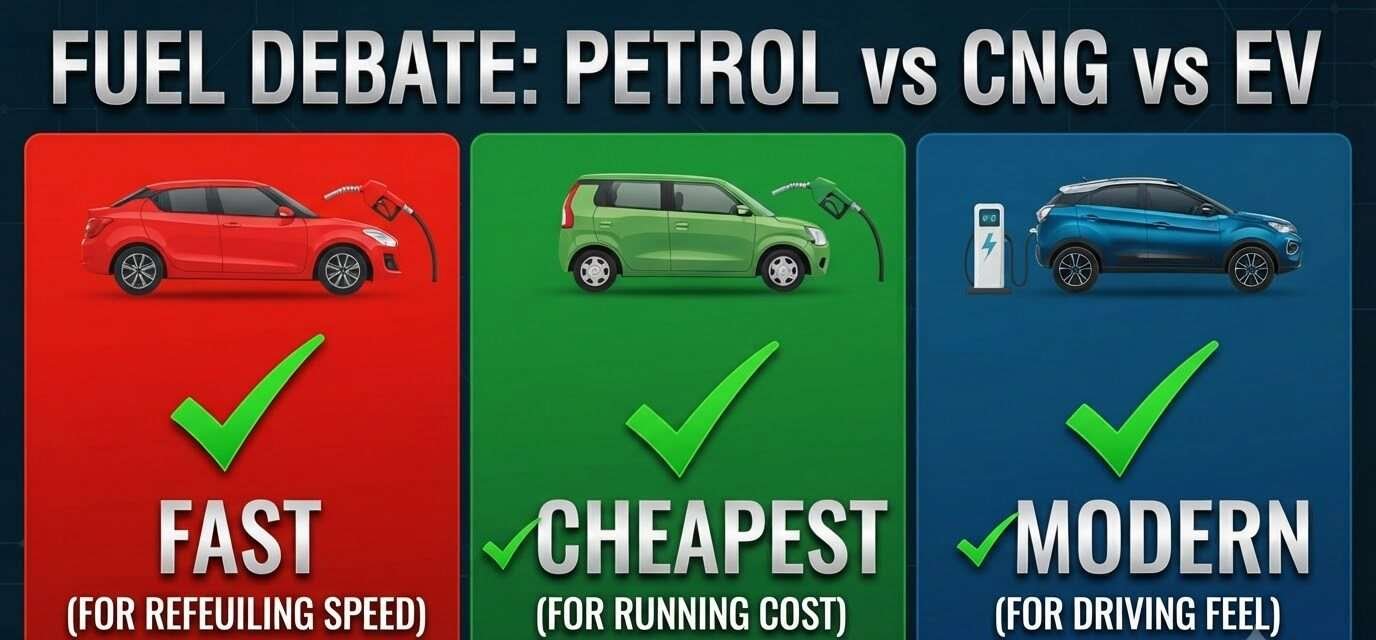
So this question comes up in literally every group chat, every dealership visit, every random conversation with a colleague who’s “finally buying a car this year.” Petrol, CNG, or EV — which one actually saves you money?
And honestly, most of the answers people give are kind of lazy. Someone says “CNG obviously, fuel is so cheap.” Someone else says “EV pays for itself eventually.” Both are true-ish, but neither means anything without actual numbers behind it. So we sat down and did the boring part — ran the math across all three, over a realistic 5 years of ownership — and the answer isn’t as clean as anyone wants it to be.
Spoiler: there’s no single winner. It really depends on how much you drive and how long you plan to keep the car. Let’s get into why.
Fuel Price Isn’t the Whole Story (Even Though Everyone Treats It That Way)
Here’s the thing nobody tells you upfront — comparing petrol vs CNG vs EV total cost of ownership isn’t just about what you pay at the pump (or the charger). Running cost is one number. Total cost of ownership is a completely different, much bigger number that includes the car’s price, insurance, servicing, how fast the battery or engine wears out, and — this one gets ignored constantly — resale value.
A CNG car can absolutely win on fuel cost and still lose overall if it doesn’t resell well. An EV can look painfully expensive on day one and still come out ahead by year 3. You genuinely can’t tell just by looking at fuel prices, which is annoying, but that’s how it is.
First, the Upfront Price Gap
Let’s not sugarcoat this one. Petrol wins here, and it’s not even close.
| Fuel Type | Typical Price Premium (over base petrol variant) |
|---|---|
| Petrol | Base price |
| CNG (factory-fitted) | ₹80,000 – ₹1,20,000 more |
| Electric | ₹3,00,000 – ₹6,00,000+ more, depends on segment |
CNG is honestly more affordable to add than most people assume, especially the factory-fitted kits (skip the aftermarket ones if you can — worse warranty, worse safety). EVs are still expensive to buy in most segments in India, though that premium keeps shrinking every year as battery costs come down.
Now the Part Everyone Actually Cares About: Cost Per Kilometre
This is where things get interesting.



Rough numbers (and yes, these move around depending on your city and the week you’re reading this):
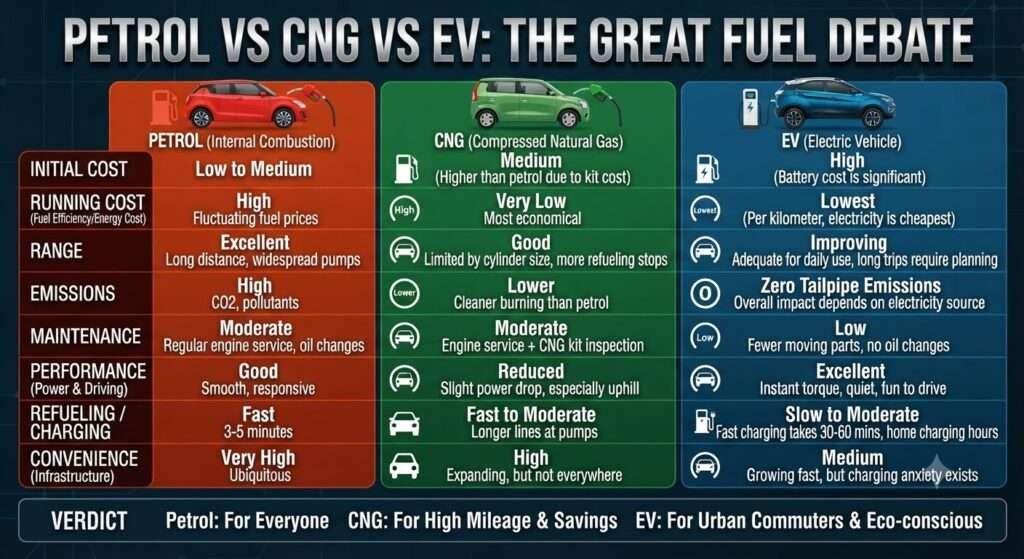
- Petrol around ₹100–105/litre, with real mileage of 15–18 km/l → somewhere around ₹5.8–7.0 per km
- CNG around ₹80–90/kg, mileage of 22–25 km/kg → roughly ₹3.2–4.0 per km
- EV charged at home, ₹7–9/unit, efficiency of 6–8 km/unit → around ₹0.9–1.5 per km
Doesn’t look like much when you write it like that, but multiply it out. Drive 12,000 km a year and the gap between petrol and EV alone can be ₹50,000–60,000 annually. That’s before you’ve even touched servicing.
Worth saying — fuel and power prices genuinely change all the time, so don’t take these as fixed truths carved in stone. If you want current numbers, the Petroleum Planning & Analysis Cell (PPAC) publishes actual government fuel price data by city, which is a more reliable source than whatever your uncle told you at a wedding.
Servicing Costs — Where Things Quietly Shift
This is the bit a lot of comparisons skip, and it matters more than people think.
Petrol cars have the easiest, most mature service network in the country. Every mechanic, in every town, knows how to fix one, and parts are cheap and everywhere. Hard to beat that.
CNG needs a bit more babysitting — spark plugs and injectors wear out faster, and the tank needs hydro-testing every few years (it’s a safety thing, not optional). Budget an extra ₹3,000–5,000 a year for this.
EVs, weirdly, are the cheapest to maintain. No oil changes, no exhaust, barely any moving parts compared to a combustion engine, and brakes last longer because of regenerative braking. Most EV owners we’ve spoken to report their service bills are 40-50% lower than what they paid on their old petrol car.
The Battery Question Nobody Wants to Think About
Okay so this is the uncomfortable part of owning an EV long-term. The battery is the single most expensive part of the car, and even with the 8-year warranties most manufacturers now offer, it does degrade — typically 2-3% capacity loss a year under normal use. Not a dealbreaker, but you should plan for it if you’re keeping the car past the warranty period, not pretend it doesn’t happen.
CNG engines, if you actually stick to the service schedule, don’t wear out dramatically faster than petrol ones. But skip the tank inspections and you’re not just risking a costlier repair down the line — you’re risking an actual safety issue.
Resale Value: The One Nobody Budgets For
This is the category that flips the whole comparison on its head and almost nobody thinks about it when they’re standing in the showroom.
Petrol cars still hold resale value best, mostly because that’s still what most used-car buyers want. Simple as that.
CNG resells decently too, especially the factory-fitted variants, and demand is actually growing as more people try to cut fuel costs.
EVs are the wildcard here. Resale depends a lot on battery health certification, and EV tech is moving fast enough that a 5-year-old EV can lose value quicker than expected once a newer, longer-range model shows up at a similar price point.
Okay, Let’s Put It All Together (12,000 km/year, 5 years)
| Cost Component | Petrol | CNG | EV |
|---|---|---|---|
| Purchase premium | Base | +₹1 lakh | +₹4–5 lakh |
| 5-yr fuel/energy cost | ~₹3.9L | ~₹2.2L | ~₹0.7L |
| 5-yr maintenance | ~₹1.0L | ~₹1.2L | ~₹0.6L |
| Resale value | Higher | Moderate | Lower–Moderate |
(These are ballpark figures based on average driving and mid-2026 prices. Your city, your car, your driving style — all of it changes the exact number, so treat this as a starting point, not gospel.)
If we’re being honest about the pattern that usually shows up: CNG tends to win if you drive a lot within the city and want your money back faster without a massive upfront hit. EVs win if you’re keeping the car 6+ years, or if you’ve got cheap home charging sorted — and there are more affordable EVs entering the market lately, worth a look in our EV section. Petrol still just makes sense if you’re a low-mileage driver, under 8,000-10,000 km a year, where honestly none of these fuel savings ever really catch up to the extra you’d pay upfront.
If CNG is where you’re leaning, we’ve already done a breakdown of the best CNG cars under ₹10 lakh in India with real mileage numbers, not brochure ones.
Three Questions to Ask Yourself Before You Decide
- How much do you actually drive in a year? If it’s under 8,000 km, fuel type barely matters — just buy the car you like.
- Can you charge at home? No home charging changes the EV math a lot, since public charging is pricier and eats into whatever you were saving.
- How long are you keeping this car? Short term — 3 years or less — upfront cost and resale matter more. Long term, running cost starts to win the argument.

FAQs
Is CNG cheaper than EV in the long run? Not really, no. EVs cost less per km to run, but CNG has a much smaller upfront cost. So CNG usually wins if you’re not keeping the car forever, and EV wins the longer you hold onto it.
Do EVs actually save money after 5 years? For people driving a lot and charging at home — yeah, often quite a bit. If you’re a low-mileage driver without home charging, the extra upfront cost might not fully pay off in 5 years.
Is CNG okay for long highway drives, not just city use? Yes, factory-fitted systems are built for that. Just don’t skip the mandatory tank testing — that part isn’t optional.
Trying to figure out your actual car budget before picking a fuel type? Read our piece on how your salary decides your car budget first.