



On a May morning, TVS Motor company’s factory on a 120-hectare campus located in the industrial enclave of Hosur in South India is bustling with activity. Workers attach handlebars to two-wheelers moving along a conveyor belt. Driverless vehicles transport materials across the gleaming factory floor. And in one section, 1,200 cc engines are being assembled for the company’s new superpremium motorbike, the Norton Manx R, one of four new models from the historic British brand now owned by TVS Motor and set to go on sale later this year.
Now Sudarshan is injecting fresh energy into TVS Motor as he looks further afield and in new directions, specifically electric motorcycles and elite machines. His ambition “is inspired by my grandfather and my father whose vision was to create a leading, global two-wheeler player”, he says in an interview at the company’s office in Singapore, from where he travels to India and elsewhere two weeks every month. In 2018, Sudarshan took up residence in the city-state, viewing it, he says, as “a good place to build a more global company”.
In a notable shift, TVS Motor edged out Japan’s Yamaha Motor to become the world’s third-largest maker of two-wheelers based on 5.5 million units sold in calendar 2025, behind Honda Motor, also Japanese, and Delhi-based Hero MotoCorp, controlled by billionaire Pawan Munjal. The company, which makes two- and three-wheelers in engine sizes ranging from 100 cc to 1,200 cc across a dozen categories, from scooters and commuter motorbikes to sport, adventure and exclusive wheels like Norton, is also the No 3 two-wheeler maker in its home market.
As Sudarshan retools the company, he’s aiming to boost production to 8.3 million units in the year to March 2027, up 41 percent from fiscal 2026 and more than double the output in 2021. To achieve that target he’s earmarked ₹35 billion ($370 million) for capacity expansion, EV development, productlaunches and scaling global subsidiaries, bringing total capex spending since 2024to ₹133 billion.
It’s all part of a roadmap Sudarshan and his father, who stepped back to become chairman-emeritus in 2023, prepared six years ago. “Many of the things that we have done, be it investing in electric [two-wheelers], the global push, the greater premium push and the focus on innovation, are… in line with the vision that we came up with in 2020,” says Sudarshan, adding that his father continues to give guidance and is “always focussed on customer delight, technology and innovation”.
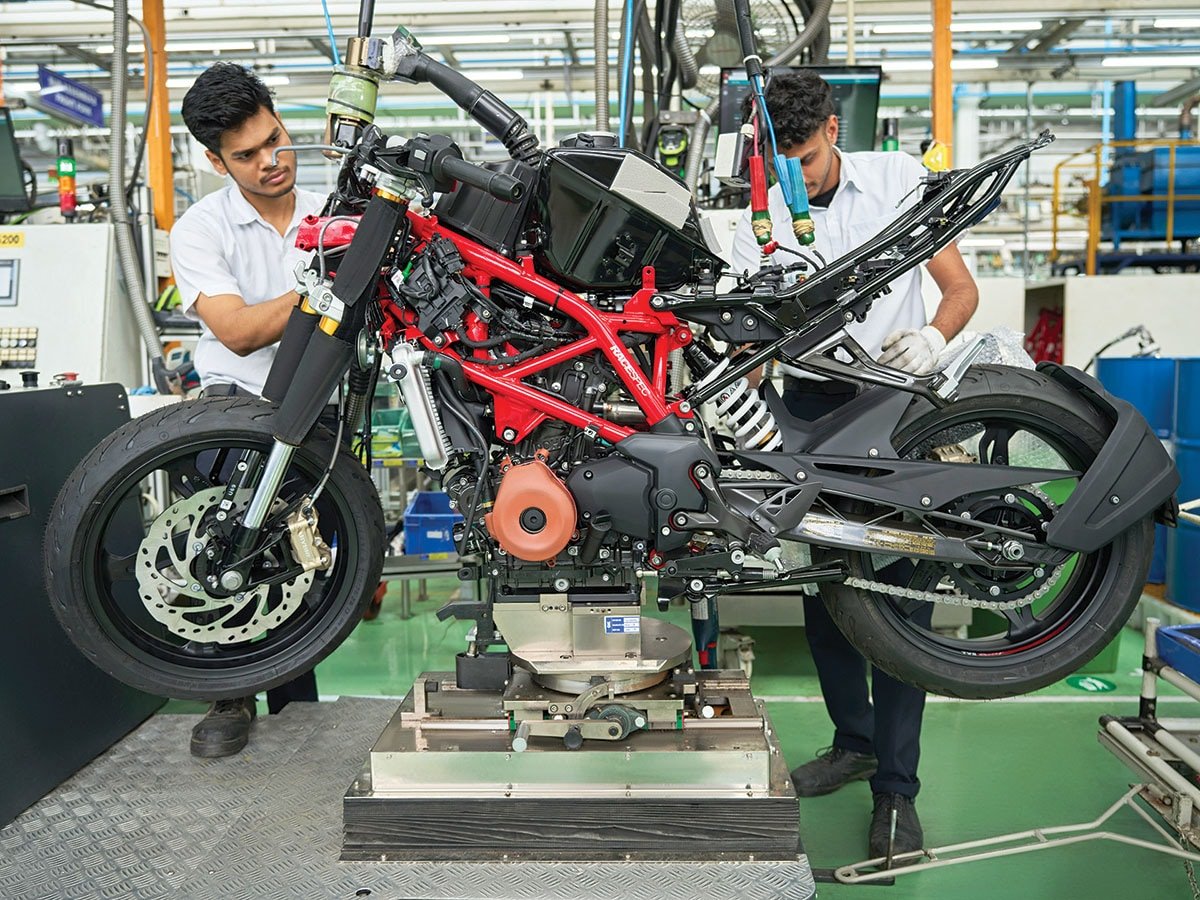
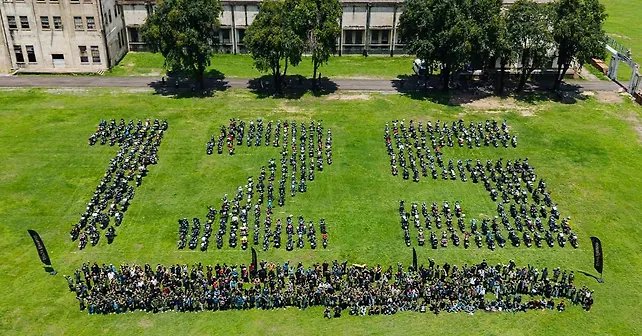
An assembly line at TVS Motor’s factory in Hosur, southeast of Bengaluru
Photo courtesy TVS motors
Sudarshan has led the company “through a period of significant achievement, driving growth across our businesses with speed and conviction, pursuing acquisitions that have extended our reach across markets”, his father says in an email.
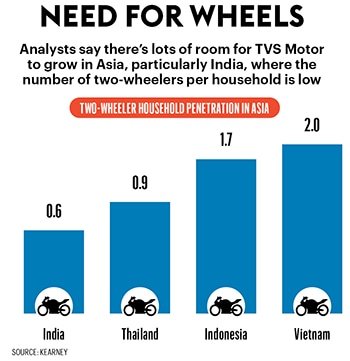
The Indian market for two-wheelers is the world’s largest by number of units, with 21.4 million sold in fiscal 2026, according to the Federation of Automobile Dealers Associations, a New Delhi-based trade group. It is expected to expand to 27.6 million units by 2030, says a report by Chicago-based consulting firm Kearney, which cites low household penetration, the surging gig economy and the country’s rising urbanisation as growth levers.
TVS Motor, which has three factories in India and one each in Indonesia and the UK, claims 19 percent of the domestic two-wheeler market and according to Autocar India, a Mumbai-based trade magazine, has 7 percent of the global market in volume terms. The Indian market accounted for nearly three-quarters of TVS Motor’s total sales of 5.9 million units in the year to March 31 (three-wheelers were 3.7 percent). The rest was exports, which jumped 31 percent to 1.4 million units in the same period.
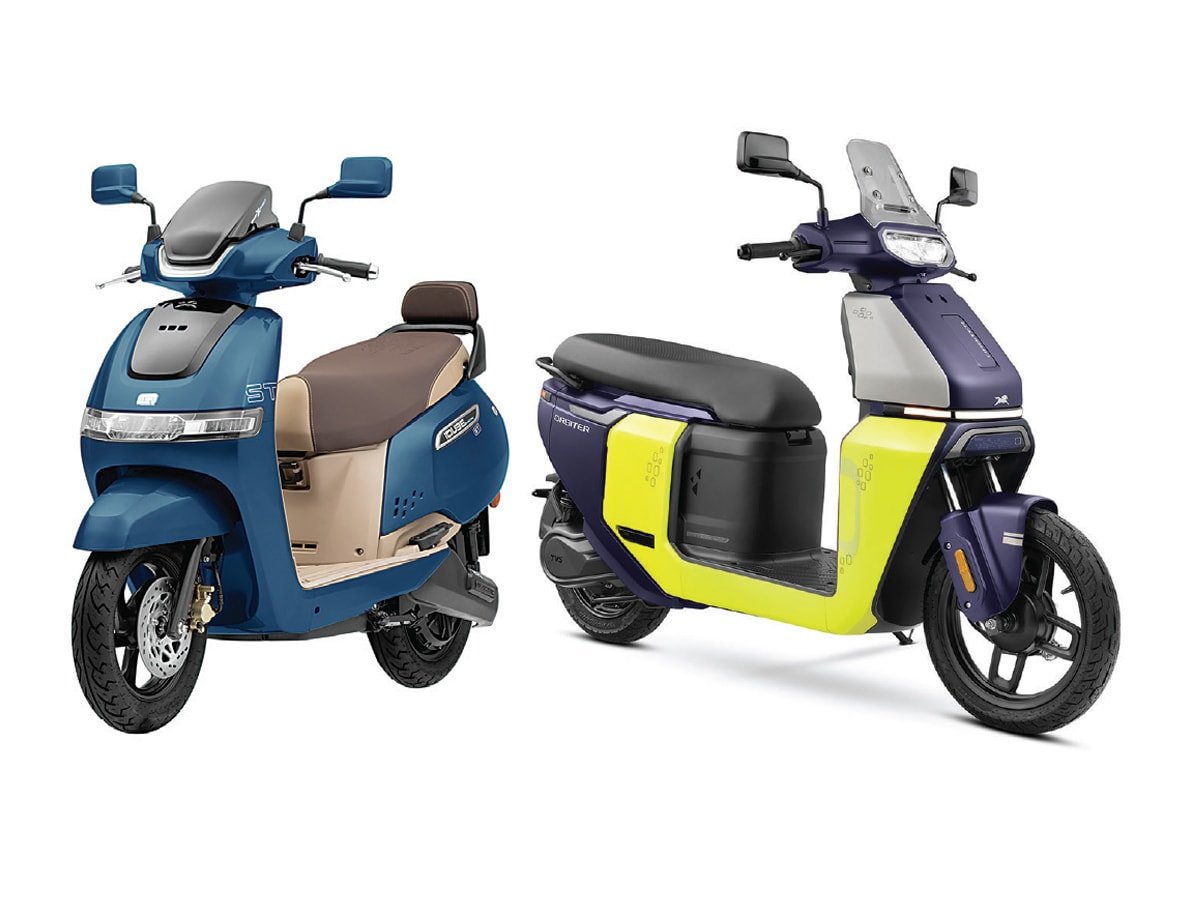
iQube (left) and Orbiter scooters.
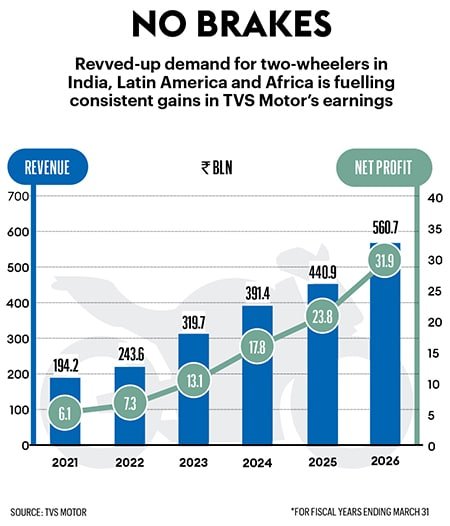
The rise in demand is reflected in the company’s consolidated earnings, with revenue and net profit soaring at CAGRs of 24 percent and 39 percent, respectively, over the five years from fiscal 2021. That performance has lifted its stock on the Indian bourses fivefold since 2021 and 25 percent over the past year. In May, an Indian arm of Goldman Sachs raised its rating on the shares to ‘buy’ from ‘neutral’, citing the company’s “superior volume visibility when compared to peers, driven by upcoming premium products”.
Other industry experts are also bullish on the company. “TVS has proven to be a great all-rounder in terms of its product positioning, portfolio breadth, its market reach, as well as its tech and manufacturing capabilities,” says Ketan Thakkar, group business editor at Autocar Professional, a B2B sister publication of Autocar India.
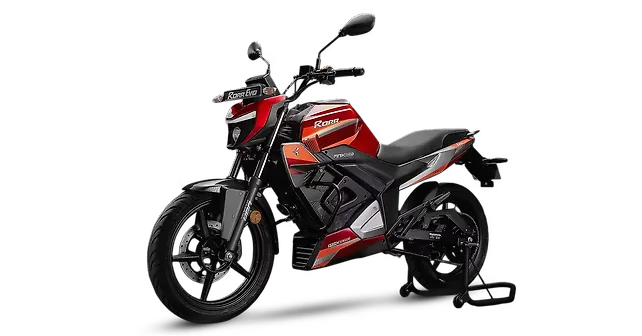
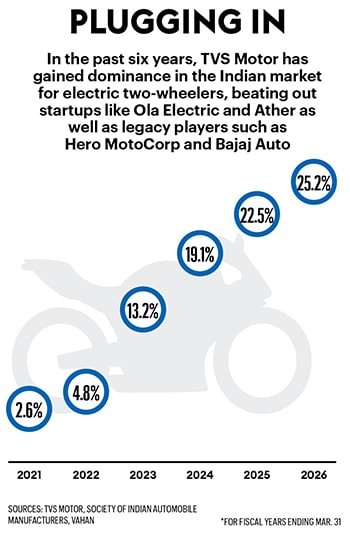
The motorbike maker’s growth over the past five years has been most pronounced in electric two-wheelers. Five years ago, TVS Motor had just one EV, the iQube scooter. Since then, it’s added the budget-friendly Orbiter and the high-performance TVS X electric scooters. As a result, the company’s domestic EV market share zoomed to 25 percent in fiscal 2026 from 2.6 percent in fiscal 2021 as it snatched the No 1 spot from rival Ola Electric last year, according to government data. Kearney reckons EVs will account for 30 percent of the total two-wheeler market in India by 2030 from 7 percent last year as commuters seek more eco-friendly rides amid volatile fuel prices.
But the market remains fiercely competitive, with startups such as Ola and Ather Energy, both based in Bengaluru, and legacy players like Pune-based Bajaj Auto and Hero MotoCorp with its Vida electric range. Foreign companies such as Vietnam’s VinFast and Japan’s Suzuki Motor are also building their presence in India across all types of EVs.
Another challenge is that the EV segment relies heavily on rare earths imported from China, giving Indian two-wheeler makers little control over supply and pricing. And components like steel, aluminium and copper coming from other parts of the globe recently were impacted by the Iran war. “We live in a very volatile environment,” acknowledges Sudarshan. “It’s uncertain both presently and possibly for a period of time. So we have to manage the risks as we go along.”
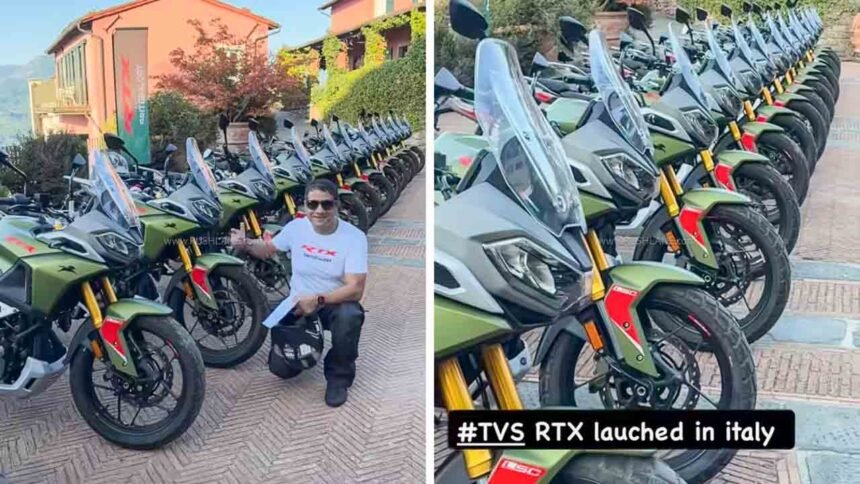
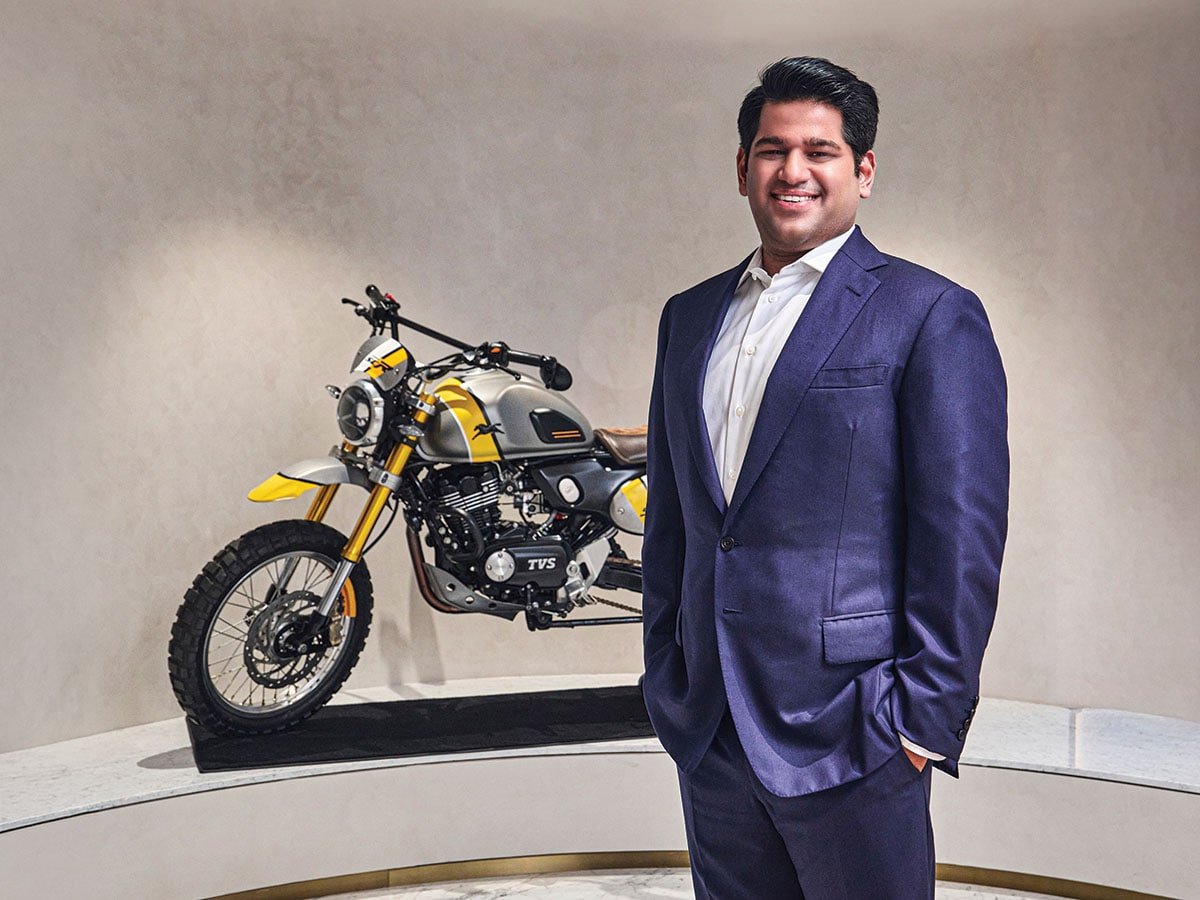
TVS Motor’s super premium and premium motorcycles are another bright spot, with domestic sales rising at a 12 percent CAGR over the past five years, surpassing overall industry growth of 5.1 percent. In 2021, the company had just the TVS Apache bike in its premium portfolio with four different versions, starting at $1,200. It has since added two more variants of the Apache and a new model, the TVS Ronin, which is displayed in the Singapore office.
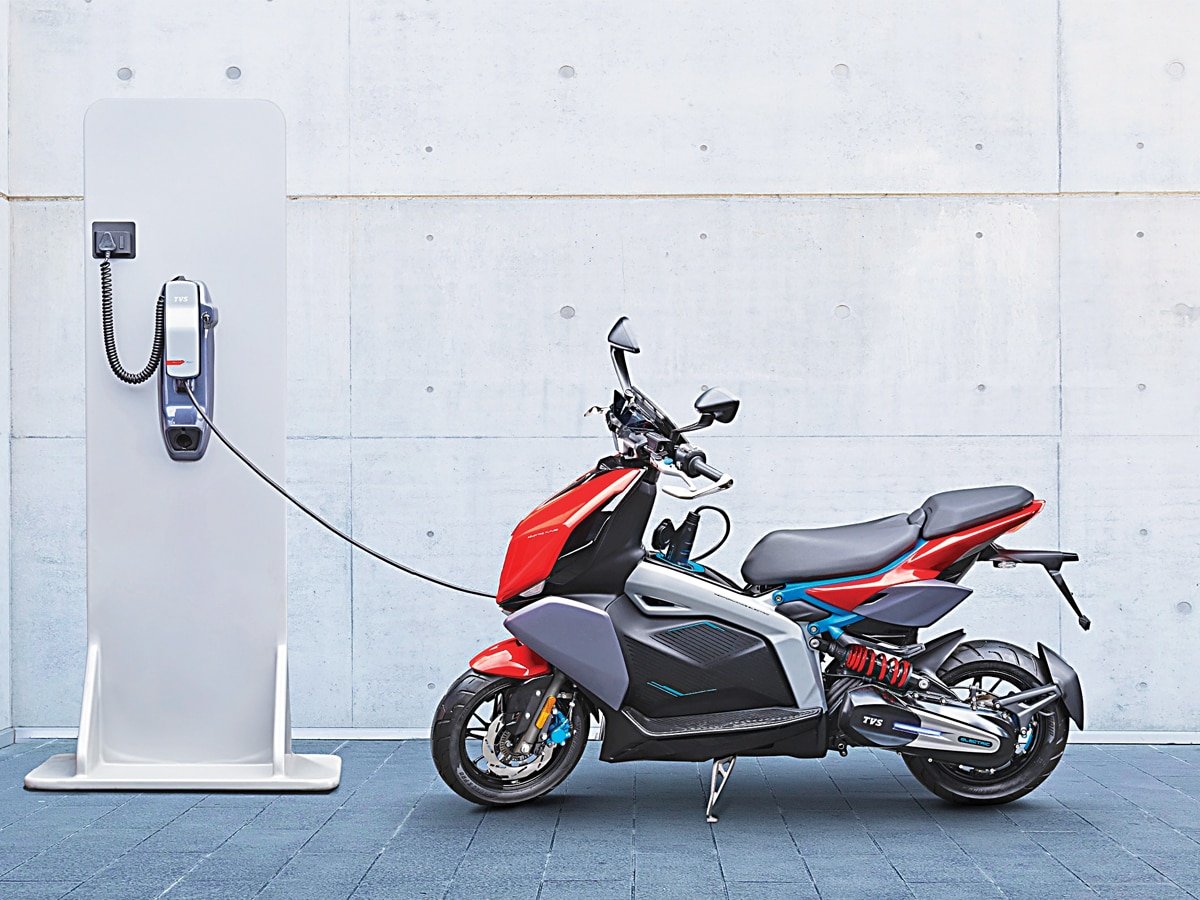
The TVS X electric scooter
Sudarshan has pinned his hopes on the iconic Norton, a more-than-century-old British brand long celebrated for its racing pedigree, innovative technology and cool designs. TVS Motor acquired Norton Motorcycles, which was under administration, in 2020 for £16 million ($21 million), then injected £200 million into its revamp. “When Norton came around, we thought it was an opportunity to transform a brand with a unique heritage,” Sudarshan says.
While the Hosur plant, southeast of Bengaluru, churns out Norton engines and also assembles some Norton models, the highest-end super premium motorbikes are hand-assembled at TVS Motor’s Solihull plant in the UK. The four new models, which are the first Nortons made under TVS Motor ownership, will launch in the UK, France, Italy, Germany, Spain, India and the US by next March, with the flagship Manx R model retailing for a base price of £20,250. “We could also grow [the brand] in many of the emerging markets with increasing affluence, where people can upgrade and enjoy these vehicles,” says Sudarshan.
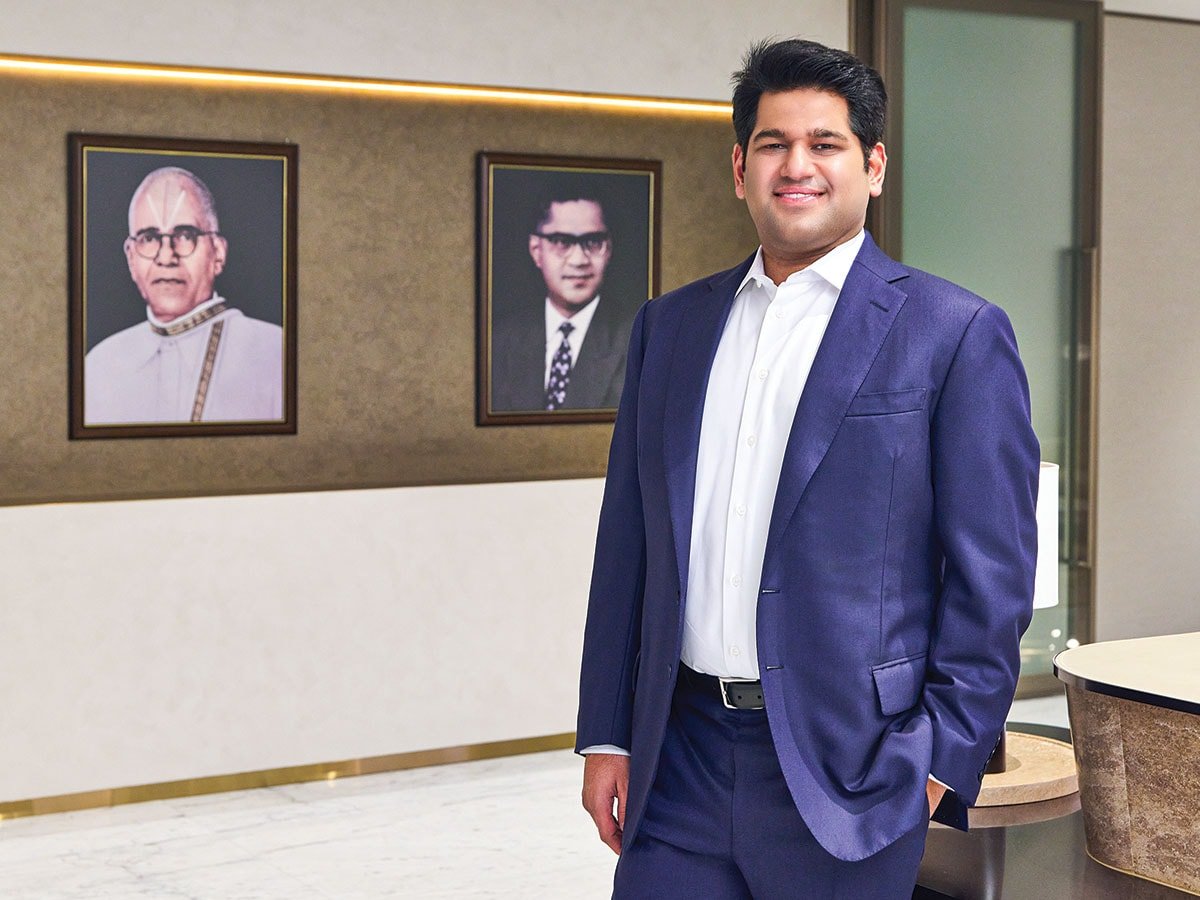
TVS Motor chairman Sudarshan Venu with portraits of his great-grandfather and TVS Group founder TV Sundaram Iyengar (left) and his grandfather TS Srinivasan, who spearheaded the push into auto components.
Photo courtesy TVS motors
But Norton is competing against heavyweights such as Italy’s Ducati, Harley-Davidson of the US and Germany’s BMW in the global market for super premium rides. There’s also Austrian marque KTM, owned by Bajaj Auto, and another British icon, Royal Enfield, part of New Delhi-based automaker Eicher Motors, controlled by billionaire Vikram Lal. The segment, which Pune-based market research outfit Dataintelo defines as machines priced above $8,000, is projected to grow at a 7 percent CAGR globally to $34 billion by 2034 from roughly $19 billion in 2025. The above-1,000 cc segment, in which Norton operates, accounted for 41 percent of the 2025 total, the report says.
Analysts warn it’s a hard segment to crack. “The category is small and TVS is a newbie,” says Autocar Professional’s Thakkar. “It will be a long game. You need the reach, you need the brand and you need the holding power.” Sudarshan is confident that Norton can hold its own. “It has great tech and connectivity,” he says, citing its “newer [internal combustion] engines, lighter-weight materials and connected helmet.” Plus, says the motorcycling enthusiast, “the riding experience is exhilarating”.
Electric two-wheelers and Norton are key spokes in Sudarshan’s desire to make TVS Motor a more global force. The company sells in 90 countries, up from 70 in 2021, and has deepened its presence in Southeast Asia, Latin America, the Middle East and Africa. But Sudarshan’s focus extends to Europe and the US. “We want to make a play in countries where we don’t have much reach now,” he says.
TVS Motor has been in Europe since at least 2021, when it bought 80 percent of Swiss electric bicycle brand EGO Movement for $19 million (unlike electric motorcycles, electric bicycles have pedals that must be used to activate the motor). A year later it bought 75 percent of Swiss E-Mobility Group (SEMG), a distributor on the continent of several e-bike brands, for $75 million, boosting its holding to 100 percent in 2023 for a further $25 million. Both EGO Movement and SEMG were subsequently wrapped into TVS Motor’s TVS eBike division, established in Zurich in 2025. But some say the company faces an uphill struggle on the continent. “The e-bike market in Europe is incredibly hard to break into,” according to Deepesh Rathore, founder of Insight EV, an online portal for the global electric vehicle industry. “You are essentially going against the Chinese factories, and China has the expertise and competitiveness in this,” he says.
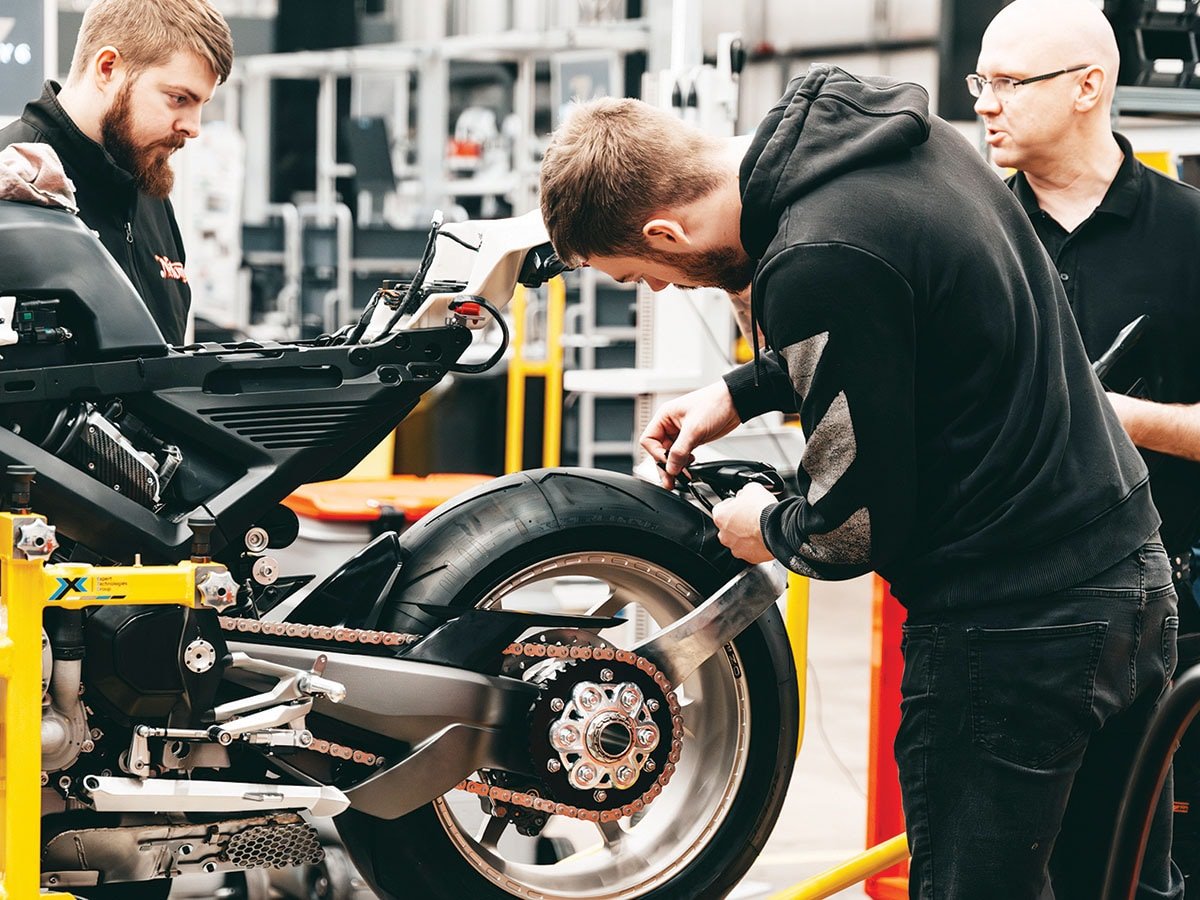
A Norton motorbike being assembled at TVS Motor’s plant in Solihull, UK.
Photo courtesy TVS motors
Also in 2023, the parent teamed up with Zurich-based Emil Frey, one of Europe’s largest car retailers and dealerships, to distribute its two-wheelers across the continent. And in April, it appointed a distributor in Malta to sell its EVs in Spain and Portugal.
By contrast, TVS Motor’s North American aspirations are “in the early stages”, Sudarshan says, but he hopes to make inroads with Norton. The US motorcycle market is projected to expand at a 5 percent CAGR to $18 billion in 2033 from $12 billion in 2025, according to an April report from Chicago-based Cognitive Market Research & Consulting.
As he seeks a broader footprint, Sudarshan has been actively scouring the globe for talent. The company has hired three executives from Jaguar Land Rover (JLR), a luxury vehicle maker based in the UK that’s owned by Tata Motors.
In January, Nick Rogers, former director of product engineering and research and a 37-year JLR veteran, was tapped as TVS Motor’s president and global chief technology officer; Bernhard Heiming, a former chief engineer at JLR joined TVS Motor in 2023 as chief technical officer; and Ralf Speth, former CEO at JLR was TVS Motor’s chairman from 2022 to 2025 and now serves as chief mentor.
Sudarshan has also sought to harness European technical expertise by purchasing Italian auto-design outfit Engines Engineering in September for €5 million ($5.7 million).
Sudarshan’s big-picture approach is a long way from the company’s roots as a bus service in the southern town of Madurai. His great-grandfather, TV Sundaram Iyengar, whose portraits adorn the walls of the Singapore office lobby as well as those of the Hosur plant, launched TV Sundaram Iyengar & Sons in 1911 and together with his sons built it into a massive transport network as well as vehicle dealerships and an auto-parts and tyre maker.
The family branched into two-wheelers in 1979 under Venu Srinivasan, who forged a partnership with Suzuki Motor for technology and engineering expertise. The pairing ended in 2001 when the TVS group bought out Suzuki’s stake and rebranded the company TVS Motor.
Four branches of the TVS family had crossholdings in group companies until they were divided among the third- and fourth-generation members in 2022, with Sudarshan’s father gaining ownership of TVS Motor. “The unlocking of value has led to more freedom and more independent decision-making,” says Kavil Ramachandran, former professor of family business governance at the Indian School of Business.
Sudarshan grew up in Chennai in a family steeped in business. His mother, Mallika Srinivasan, has separate business interests as chairman and managing director of the $1.5 billion (fiscal 2025 revenue) tractor maker TAFE, an inherited family business where Sudarshan’s only sibling, sister Lakshmi Venu, is vice chairman. After his schooling in Chennai, he did a dual undergraduate degree in mechanical engineering and economics at the University of Pennsylvania’s Wharton School, graduating in 2010 and going on to earn a master’s in international technology management at the UK’s University of Warwick.
He returned home to join TVS Motor as vice president, becoming a director in 2013 and joint managing director a year later. In 2022, after almost a decade in which he helped scale the iQube scooter platform, extended the company’s global reach and made his audacious bid for Norton, he was made sole managing director. In 2025, he succeeded Speth as chairman. His efforts have been noted by the industry. “Sudarshan is planning for the next 20 years and not just for the next four quarters,” says Insight EV’s Rathore. “He is positioning TVS Motor in markets and segments where it would not have gone before.”
While the young boss maintains that he’s “inspired by our values and tradition,” he’s clear that building global capabilities is the way forward. He has a vote of confidence from his father, who says: “I am sure that the most significant chapter of this story still lies ahead.”