




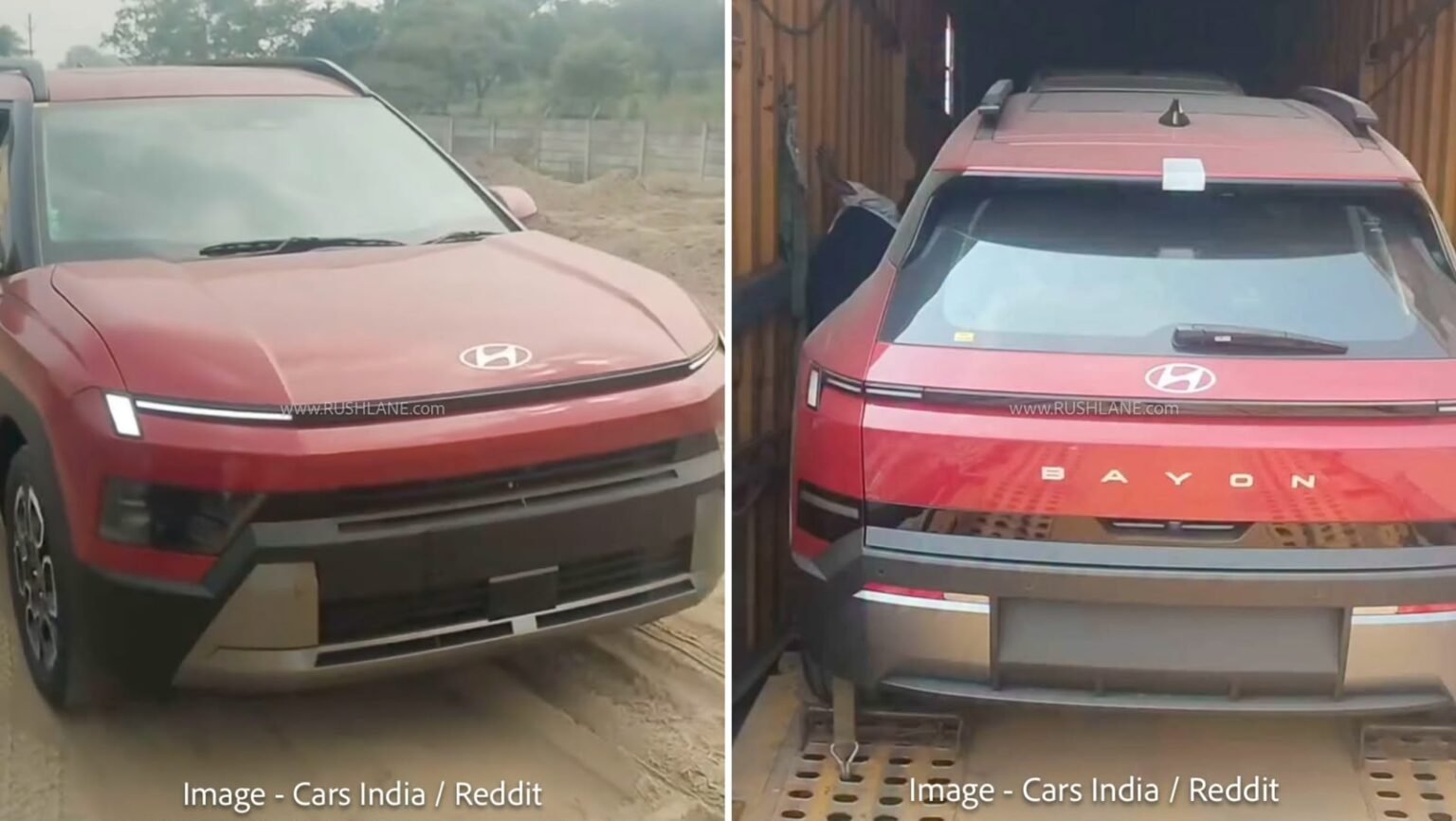
Seen in red, the India-spec Hyundai Bayon makes a strong visual impression, with fresh images offering a closer look at its exterior and cabin
Hyundai officially revealed the India-spec Bayon last week, and the first units have now started reaching dealer yards ahead of its October 26 launch. Fresh images leaked online offer a first look at the SUV in real-world surroundings – and it makes a stronger impression than Hyundai’s official photographs suggested.
The new Hyundai Bayon is looking sharper in the flesh. The red bodywork brings out the sculpted panels, while the black cladding and silver bumper inserts give it a substantial SUV appearance. Measuring 4.2 metres in length, Bayon will slot between Venue and Creta in Hyundai’s India lineup. Bookings are already open for Rs 11,000.
Hyundai Bayon First Real World Images
The front is particularly striking in these images. Slim H-Edge LED daytime running lights sit along the bonnet’s leading edge, with vertical elements at the outer ends. A black strip visually connects the two sides, emphasising the width of the SUV without making the upper fascia look busy.
The main headlamps sit lower down, flanking a broad grille. Generous black bumper sections and contrasting silver inserts give the front a more rugged appearance, while two prominent bonnet creases add definition. Seen outdoors, these elements come together well, giving Bayon a distinct identity within Hyundai’s SUV range.
The side and rear-quarter views reveal angular wheel arches, substantial cladding and geometric alloy wheels. Blacked-out pillars contrast with the red body, while raised roof rails add to the upright stance.
Rear Styling Mirrors The Front
At the rear, Bayon carries a similar horizontal-and-vertical lighting theme. A slim black strip stretches across the tailgate, with lighting elements at either end. Spaced-out BAYON lettering sits below the Hyundai emblem, making the model’s identity clear.
The rear bumper features a large dark section with contrasting silver inserts at the corners. A roof spoiler, rear wiper, shark-fin antenna and parking sensors are also visible. The relatively upright tailgate and broad rear treatment give the SUV a planted appearance.
Closer Look At The Cabin
The interior images provide a closer view of the dashboard and centre console already seen in Hyundai’s official reveal. The dual-tone cabin combines lighter lower sections with a darker dashboard, while the digital instrument cluster and infotainment display sit prominently ahead of the occupants.
Hyundai has confirmed two 12.3-inch screens housed in a curved panoramic panel. Below the infotainment screen, the photographed vehicle has a row of physical shortcut buttons, including media, map and home controls, alongside the hazard switch and rotary knobs.
The central climate-control panel sits between two vertical AC vents, with a large rotary control at its base. Two USB-C ports and a storage area are visible below. The automatic gear selector identifies this particular vehicle as the IVT version, while the driver’s side images show steering-mounted controls and a push-button start.
AI And Connected Features Already Confirmed
Technology forms a major part of Bayon’s positioning. Hyundai has confirmed a generative AI voice assistant combining Perplexity and SoundHound AI technology. It supports conversational requests in English, while a separate set of more than 500 offline voice commands supports six languages, including Hindi and Hinglish.
Bayon also gets Hyundai’s NVIDIA-accelerated Connected Car Navigation Cockpit, or ccNC, along with more than 70 Bluelink connected features. Over-the-air updates are supported for up to 19 vehicle controllers. Variant-wise availability of equipment will be an important detail at launch.
115 PS Petrol Engine – Prices On October 26
Power comes from a four-cylinder, 1.5-litre MPi petrol engine producing 115 PS and 144 Nm. Buyers will have a choice of a six-speed manual or IVT automatic transmission. Pricing and the variant wise features will determine its positioning between Venue and Creta when it launches on October 26.