




- Bayon CNG set for Jan 2027 debut
- Elevate facelift launched on 6 October
New to the game
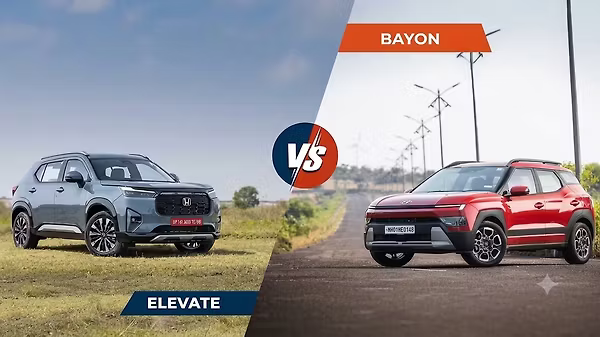
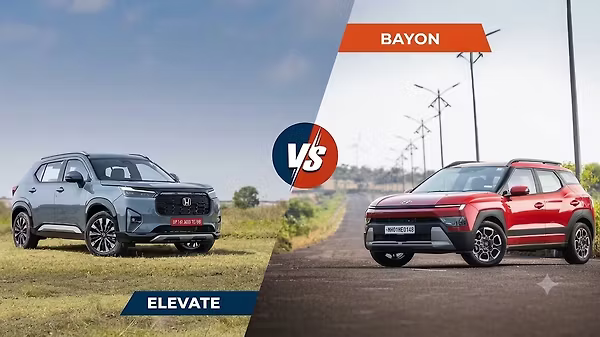
Hyundai is taking a two-pronged approach to the D SUV fight ahead of the next-gen Creta’s arrival. This second prong is the Bayon SUV, whose role (down the line) will be to fill the spaces left by the current Creta’s lower-spec variants. We have driven the car and can tell you Hyundai’s got a good package on its hands but will face some stiff competition from Honda who recently launched a facelift for their Elevate SUV.
Specifications and dimensions
Both the Hyundai Bayon and the Honda Elevate are offered with a 1.5-litre NA petrol engine, available with a six-speed MT or a CVT. Outputs stand at 113bhp/143Nm for the Bayon and 119 bhp/145 Nm for the Elevate, respectively. The pre-facelift Elevate was offered with a company-approved CNG kit, fitted at the dealer and available only with the six-speed MT, but Hyundai has not officially announced a CNG option for this Elevate facelift.
Hyundai, on the other hand, has officially announced that the Bayon will get a CNG version in January 2027. This will be the same package found on the Kia Carens Clavis CNG, where the engine produces 95bhp and 123Nm and can only be had with the six-speed MT. On the dimensions front, the Bayon measures in at 4.24 metres with a wheelbase of 2.60 metres, while the Elevate is slightly larger at 4.32 metres with a wheelbase of 2.65 metres. Finally, the Bayon’s boot is 505 litres, while the Elevate’s stands at 458 litres.
Feature fight
Where they are separated in terms of dimensions and engine output, at the top end both cars offer a very similar feature list. This includes LED lighting, climate control with rear AC vents, Level 2 ADAS, TPMS, 360-degree camera with blind spot monitor, connected car technology, ventilated front seats and USB-C fast-charging ports. However, over the Elevate Bayon gets more functions for the ADAS system, full digital instrument cluster and a two-step reclining rear seat.
The differentiating factors
Top-end to top-end, the Bayon and the Elevate are separated by Rs. 19000 and if you are willing to add another Rs. 6000 then you can get the Elevate ZX+ Dark. It is likely that within the next few months Hyundai may introduce a special edition for the Bayon whose pricing is likely to cover or go past this delta to the Elevate ZX+ Dark. On a surface level, both cars offer very similar packages, but dig deeper, and we can see the Elevate is bigger and a little more powerful, while the Bayon has more features and will get a company-fitted CNG kit.