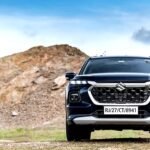


For the new Tomahawk PHEV, JSW MG Motor India organised a media drive with a challenge: cover approximately 1,000 km from Ahmedabad to Delhi NCR on one full tank and one full battery charge. To ensure neither was replenished along the way, MG sealed the fuel filler cap and charging flap before we set off.
We completed the journey, giving us an opportunity to assess the MG Hector Tomahawk PHEV’s long-distance capability and how its petrol-electric powertrain behaves during sustained highway driving. Over two days behind the wheel, we also evaluated its comfort, practicality and everyday usability. Here’s what impressed us—and where it could improve.
Hector Tomahawk PHEV Review
Plug-in hybrids have largely been confined to India’s luxury segment. The MG Hector Tomahawk PHEV brings the technology to a more accessible price point, at Rs 25.7 lakh for the Exclusive and Rs 27.8 lakh for the Essence, both ex-showroom. Its closest hybrid alternative is the Toyota Innova Hycross, while buyers could also consider the Mahindra XUV7XO, XEV 9S, Tata Safari and Harrier EV, depending on their seating and powertrain preferences.
Pricing is competitive considering the plug-in hybrid system and its 20.5 kWh battery pack. Greater policy support could make such vehicles more accessible, although any case for tax incentives should account for how regularly they are charged and driven on electric power.
The Hector Tomahawk PHEV shares most of its exterior design with the Hector Tomahawk EV, with the front fascia being the main point of distinction. Styling is subjective, but the PHEV’s front-end treatment did not particularly appeal to me. As with the EV, its relatively narrow body compared with its length and height gives it a slightly tall, slab-sided appearance.
Length is 4,745 mm, width is 1,850 mm, height is 1,770 mm and wheelbase is 2,810 mm. Hector PHEV comes with three-row seating and boot space is 192L with all three rows up and 528L with third row folded. It rides on 18-inch wheels and after experiencing the LED headlights in the dark, we were not impressed in any way. The powered tailgate is similar to Hector EV and the rear gets independent suspension as well.
Luxurious Feeling Interiors
Inside, the Hector PHEV closely resembles the EV, with a darker shade of brown distinguishing the cabin. This drive also gave us an opportunity to assess the seven-seater layout, which we had not experienced in the EV. The second row’s left-hand 40% section features a one-touch tumble function, creating a reasonably sized opening to access the third row. At six feet tall, I found the rearmost seats cramped, with a knees-up seating position. Third-row occupants do, however, get roof-mounted AC vents, cupholders and adjustable headrests.
Strengths and weaknesses of MG Hector PHEV are almost identical to that of Hector EV. There is good space and comfort in both first row and second row. Cabin width is decent and there are a lot of soft touch plastics across the cabin. We get soft touch elements on door pads, dashboard, armrests and in centre console. Even the parts where driver and co-driver’s knees would touch on door and centre console, are all softly padded. This area is slightly less padded in EV.
Climate control has physical toggles on centre console, but they’re a bit of a stretch even for my long hands. Infotainment screen gestures are intrusive as they get triggered randomly, even when you’re just zooming in Maps. Ventilated seats and driver’s memory seat settings are buried in this screen, along with a lot of other vehicular functions. Driving in sunny Gujarat and Rajasthan, I felt like the sun visors should have been extendable, which is not the case.
Infinity speakers are very punchy with deep bass. So punchy that these speakers strongly rattle all door pads and dashboard even at low volumes of 20/100. Also, audio controls on steering increase volume in increments of 5 (example, 10 to 15 to 20), which was quite bizarre. There’s roof mounted AC vents, panoramic sunroof, ambient lighting, rear sun shades, sliding and reclining rear seats and more. The only major missing in Hector PHEV is rear ventilated seats.
PLUG-IN HYBRID POWERTRAIN!
The Hector PHEV has a claimed combined range of 1,100 km, with its 20.5 kWh battery rated to deliver 115 km of electric-only driving. We began the Ahmedabad–Gurugram journey with a full 52-litre petrol tank and a fully charged battery. The dashboard initially displayed 117 km of electric range and 995 km of petrol range, adding up to an estimated 1,112 km.
We completed approximately 1,000 km without refuelling or recharging. At our destination, the display still showed 18 km of electric range, while the petrol range had fallen below the 50 km threshold at which the system stops displaying a numerical estimate. We therefore could not establish the exact combined range remaining.
We used Standard mode throughout rather than Eco and made no deliberate attempt to hypermile. The drive included sustained highway running at triple-digit speeds, making this a useful demonstration of long-distance capability under the conditions we encountered.
For roughly the first 140 km after leaving Ahmedabad, the Hector PHEV operated predominantly in EV mode, with battery charge gradually falling to around 20%. The petrol engine then became more involved as the system managed the remaining charge. In series-hybrid operation, the engine generates electricity while the electric motor drives the wheels; in other operating modes, the engine can also contribute mechanical drive. Transitions felt seamless, with little intervention required from the driver.
For much of the remaining journey, the Hector PHEV effectively operated as a charge-sustaining hybrid. We observed displayed petrol consumption of around 4.6 litres/100 km, equivalent to approximately 21.7 km/l. With a higher battery charge earlier in the drive, displayed consumption was as low as 1.8 litres/100 km. However, these dashboard readings were not independently measured tank-to-tank figures, and the lower petrol consumption also relied on stored electrical energy.
Regular charging could reduce petrol use substantially, particularly on journeys within the car’s electric range. On longer trips, the benefit would depend on charging opportunities, driving conditions and the time available for stops.
Drive & Handling
While the powertrain certainly impressed us the most, the next most impressive aspect of Hector PHEV is ride quality. Suspension is softly sprung and we get independent suspension at all four wheels. Bump absorption is commendable, while suspension noises can be heard in the cabin. Also, wind noise and tyre noises creep into the cabin too, which could have been better contained.
Handling is one area where the Hector PHEV could improve. There is noticeable body roll through corners, while the steering offers limited feedback. Three steering settings are available, but even the sportiest did not deliver the precision or confidence we would have liked. Disc brakes at all four wheels provide adequate stopping performance, although pronounced nose-dive under braking reinforces the SUV’s comfort-oriented character.
Who Is It For?
With its plug-in hybrid powertrain, Hector PHEV tries to appeal to a wide range of audiences that are currently juggling Petrol and Hybrid options for cost-effective commutes. Someone like me, actually. Across 4 vehicles (Diesel MT), my family has driven around 8 lakh kilometers and I wished Indian market had mainstream PHEVs since the dawn of this technology. Most of our commutes happen between home and farm house, which is a 180 km (two-way) commute.
If I project these commuting needs on Hector PHEV, my running costs would be less than halved every single time, when compared to Diesel Manual vehicles we currently drive. I cannot buy a fully electric vehicle because my driving needs are spontaneous, uncalled and random. If I recharge at the farm house, I can even do the whole round trip in just electric battery. At the same time, have the dependability of the Petrol engine drawing from the 52L tank.
Most of the commutes I take besides the farm drives, also fall in the 200 – 300 km mark (two-ways). MG Hector PHEV fits my driving needs like a hand in glove. If you have similar driving needs or just want to be in the loop of cutting-edge automotive tech, MG Hector PHEV is a compelling option.
Should You Buy One?
The MG Hector Tomahawk PHEV makes a convincing case for buyers seeking electric driving for everyday use without giving up the flexibility of a petrol engine on longer journeys. Completing our approximately 1,000 km drive without refuelling or recharging demonstrated its touring capability, while the comfortable ride, spacious first two rows and well-appointed cabin added to its appeal.
There are compromises. The third row is cramped for taller adults, some frequently used functions are buried in the touchscreen, and cabin rattles and road noise leave room for improvement. Noticeable body roll, limited steering feedback and nose-dive under braking also make it better suited to relaxed driving than enthusiastic cornering.
At Rs 25.7–27.8 lakh, ex-showroom, it deserves consideration as a comfortable family SUV with a versatile powertrain. Buyers who can charge regularly are best placed to benefit from its electric capability and reduced petrol use. Those who rarely plug in should assess its running costs against conventional hybrids and diesel alternatives.