



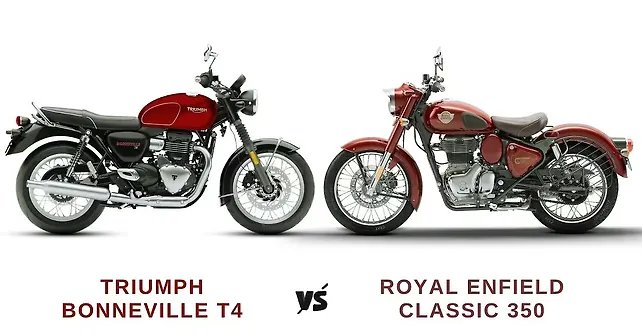
- T4 has more power, a sixth gear and riding modes
- Classic 350 has a proven low-revving engine, relaxed road manners and a much lower entry price
- At the top end of the Classic range, the price gap narrows enough to make the new Triumph a serious alternative
Get your retro face on, the Triumph Bonneville T4 and Royal Enfield Classic 350 are here to add a flavour of heritage to your fast-paced life. Both these made in India classics deliberately look backwards in time. Outfitted with round headlights, teardrop fuel tanks, long mudguards, exposed engines, upright riding positions and twin-shock rear suspension, these motorcycles trade heavily on names and shapes that existed long before modern engineering was conceived.
Design and Heritage
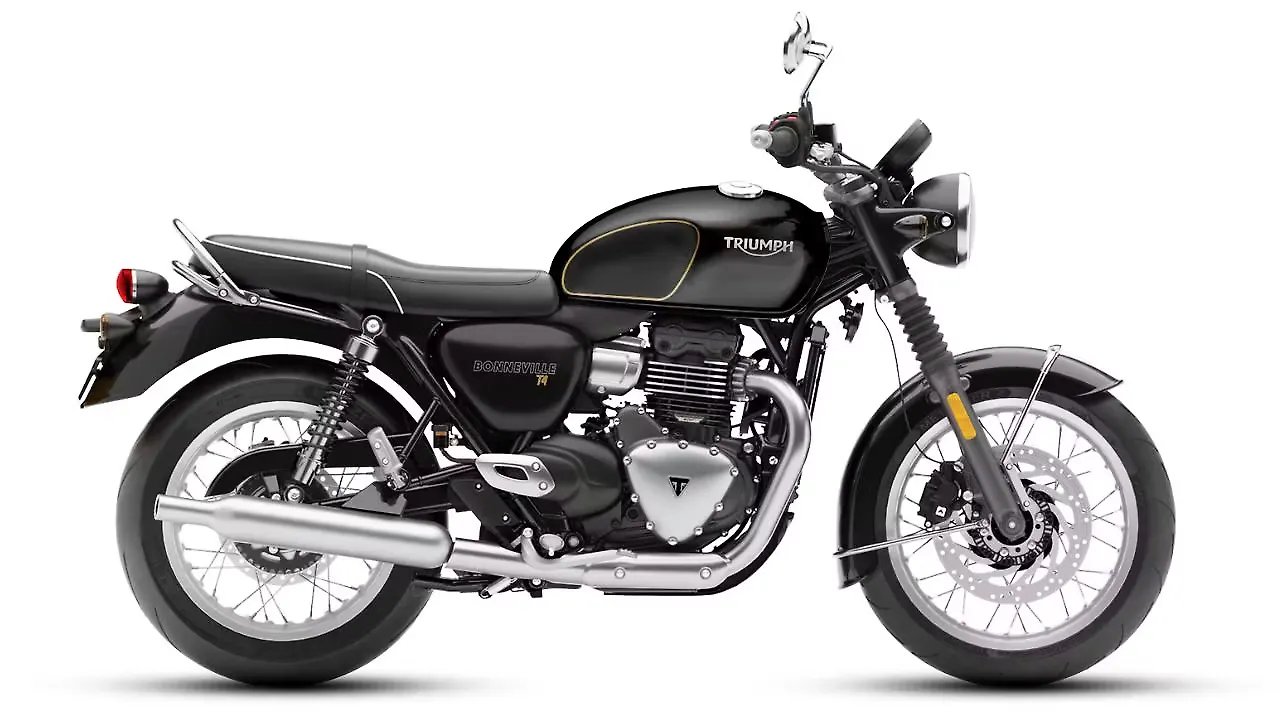
Bonneville has its roots back in the original T120 from 1958. Named after the venerable Bonneville Salt Flats where Triumph pursued speed records, it became one of the defining British motorcycles of the following decade. T4 is able to carry those proportions expected of this family with its traditional teardrop tank, extended mudguards, bench seat, peashooter-style silencer, twin rear shocks and those gorgeous aluminium-rimmed wire-spoke wheels. Even the engine has been visually dressed with machined fins harking the days gone by.
Classic 350 has an equally rich story. Royal Enfield says its design traces back to the post-war Model G2 while the modern Classic appeared in 2008 and went on to become one of the motorcycles most closely associated with Royal Enfield’s revival. The casquette headlamp, curved mudguards, teardrop tank, side boxes, upright stance and large engine area have changed remarkably little in visual spirit.
Its identity has been reinforced by millions of kilometres on Indian roads and generations of owners. The Bonneville name carries enormous global history, but the 350cc T4 now needs to establish what a small Bonneville means to an Indian customer.
There is also a meaningful price difference. The Bonneville T4 costs Rs. 2,54,999 ex-showroom Delhi. The Classic 350 starts at Rs. 1,87,434 and rises to Rs. 2,23,275 for the Emerald version. Comparing the cheapest Classic with the Triumph would therefore make little sense. The more relevant contest is between the T4 and a top-spec Classic, where the difference falls to about Rs. 32,000.
Performance Is Only Half the Story
On a specification sheet, the Triumph beats the Royal Enfield as if on a drag run on the Bonneville Salt Flats. The new 350cc liquid-cooled four-valve DOHC single develops around 28.3bhp at 7,000rpm and 31.2Nm at 5,500rpm. It comes with a six-speed gearbox with slip-and-assist clutch.
Classic’s 349cc air-oil-cooled single produces 20.2bhp at 6,100rpm and 27Nm at just 4,000rpm. It only has a five-speed gearbox though. The Triumph therefore has around, ahem, 40 percent more power with slightly more torque and an extra gear.
However, this is exactly where the Classic 350 demonstrates why numbers can be misleading in this category.
Our experience with the Classic has repeatedly shown that its appeal is centred on how little effort it asks of its rider. This long-stroke J-series engine pulls smoothly at city speeds, its torque arrives early and you need not chase the redline at all. Leave it in a taller gear, let the engine work lazily and enjoy the measured rhythm.
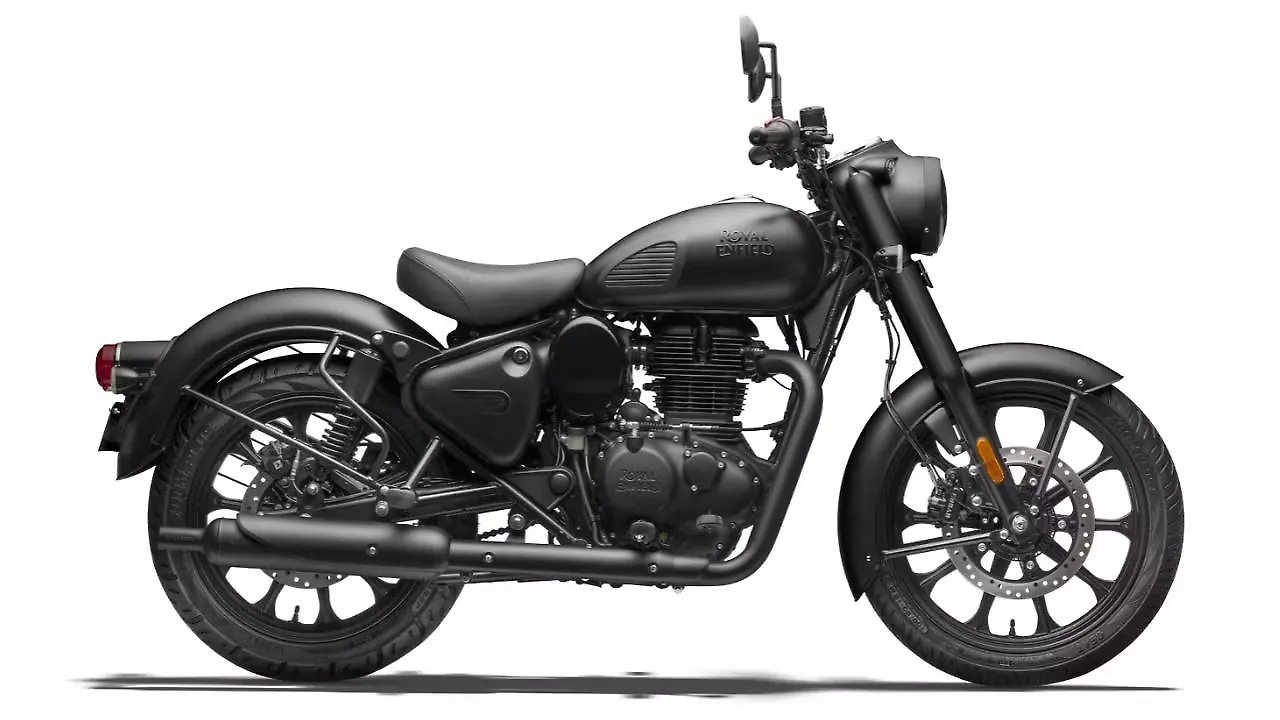
It is not fast. Highway overtakes require planning and riders chasing strong acceleration will quickly find its limits. Yet, ridden at 70-90kmph, the engine, neutral ergonomics, broad seat and steady chassis work together particularly well. That is why adding another ten horsepower does not automatically make another motorcycle a better Classic.
Triumph appears to understand this. The Bonneville version of its 350cc TR-series engine has been specifically tuned differently from the company’s sportier small motorcycles. Triumph has concentrated on low and mid-range response, uses a lower idle speed and has tried to make the firing pulses more noticeable. The objective is clearly to make the engine feel less clinical and more appropriate for the Bonneville badge.
The architecture is nevertheless very different. An 89mm bore and short 56.1mm stroke make the Triumph far more oversquare than the Classic’s 72mm bore and 85.8mm stroke. It should therefore be happier revving higher, while the Royal Enfield remains fundamentally a long-stroke that builds its appeal at lower engine speeds.
The T4 also gets Road, Rain, and Eco riding modes. Its more expensive T40 sibling adds configurable modes, cruise control, cornering ABS, cornering traction control and a four-inch TFT. T4 instead uses a colour LCD, conventional dual-channel ABS, turn-by-turn navigation, and Bluetooth connectivity. That is still much more electronic sophistication than the Classic offers by a country mile.
Interestingly, both weigh 195kg. Triumph has a more accommodating 790mm seat height against Royal Enfield’s 805mm saddle. T4 also offers 130mm suspension travel at both ends, while the Classic combines 130mm at the front with 90mm at the rear. Remember when we said that the Classic feels harsh on bad roads, that’s why. Bonneville uses an 18-inch front and 17-inch rear wheel, whereas the Classic’s has a more traditional 19-inch front and 18-inch rear combination.
We already established that the Classic is comfortable and reassuring at normal speeds, even if its rear suspension can feel firm over sharper broken patches. The Bonneville T4 was launched only recently and has not yet undergone the same full road test. Until that happens, its greater suspension travel and superior performance are advantages on paper rather than proof that it offers a more satisfying real-world ride.
Who Should Buy Which?
For the traditional Classic 350 customer, the Royal Enfield continues to make enormous sense. It is considerably cheaper in lower variants, has an enormous dealer and service presence, offers a vast accessories ecosystem and has one of the strongest identities of any motorcycle sold in India. Its limited performance is almost beside the point for somebody who wants relaxed Sunday rides, city commutes, occasional touring and that familiar Royal Enfield experience.
Classic also has a broader price spread where a buyer can enter below Rs. 1.90 lakh and move through multiple trims before reaching roughly Rs. 2.23 lakh. You get to pick between alloy wheels and tubeless tyres available on selected versions, and can choose between understated colours, military-inspired themes, dark and chrome finishes.
Bonneville T4 will appeal to the riders who would rather prefer the Classic idea packed with more performance and modern engineering without abandoning the blast-from-the-past status. The added benefit of the sixth gear should make sustained highway riding easier and the additional power will provide more flexibility for overtaking. Riding modes, Bluetooth connectivity, LED lighting and longer service intervals further add to the premium argument.
It may also attract riders who previously liked the Bonneville T100 or T120 but could never justify their much higher prices. At Rs. 2.55 lakh, Triumph is putting the Bonneville name into a completely different part of the Indian market.
The T40 at Rs. 2.80 lakh moves further away from the Classic 350. It’s TFT, full-map navigation, cruise control, configurable riding modes and lean-sensitive electronics make it a significantly more advanced product, but also one that competes less directly with Royal Enfield on value.
T4 is therefore stands as the more interesting comparison. Spend around Rs. 32,000 above the most expensive Classic and the Triumph offers you stronger specifications. If you’re judging a motorcycle through performance, equipment, finish and highway capability, that premium on the Triumph is worth every penny.
Classic 350 wins through something less tangible. It already knows what it is and can do. That engine note, slow-revving response, steering weight, upright posture and unhurried pace combines into an experience that owners have valued for years.