


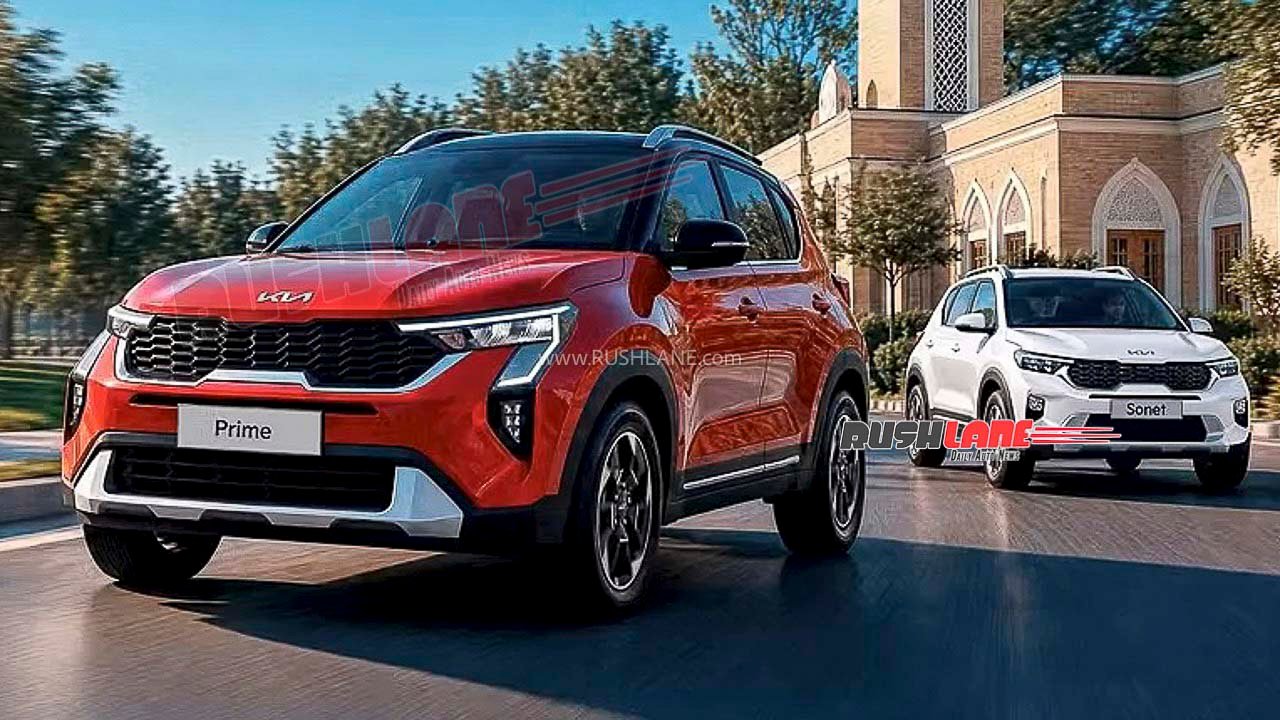
The facelifted Sonet joins the older model in Uzbekistan, bringing updated styling, larger screens and additional features, with local assembly at the ADM Jizzakh plant.
Kia has introduced the Sonet facelift in Uzbekistan under the Sonet Prime name. Priced from UZS 269,900,000 (Rs 22.17 lakh), the updated SUV will be sold alongside the pre-facelift Sonet, which continues to start at UZS 199,900,000 (Rs 16.42 lakh). Both versions are assembled locally at the ADM Jizzakh plant using CKD kits. Uzbekistan is among Kia India’s export markets.
Prime name helps distinguish the facelift from the older model, giving buyers a choice between the more affordable existing Sonet and the newer, better-equipped offering. Sonet Prime is available in a single Prestige trim, while the pre-facelift model continues in five variants.
Sonet Prime Gets Slightly Different Exterior Styling
Uzbekistan-spec Sonet Prime follows the familiar design direction of the facelift sold in India, with a Tiger Nose grille, sleek headlamps, angular Star Map LED DRLs and connected LED tail lamps. However, changes around the bumpers and fog-lamp housings give it a slightly different appearance.
At the front, vertically stacked fog lamps sit within tall housings at the outer edges of the bumper. The lower air intake is framed by a prominent silver skid-plate-style insert, while silver detailing along the grille’s lower edge adds contrast. These elements distinguish its front-end treatment from the India-spec Sonet shown here.
The rear carries the facelift’s connected lighting signature, with vertical outer sections extending down either side of the tailgate. A broad silver lower bumper insert reinforces the contrasting exterior treatment. Roof rails, wheel-arch cladding and geometric dual-tone alloy wheels (diff design than India) complete the SUV’s appearance.
The Uzbekistan-spec Sonet measures 4,120 mm in length, compared with the sub-four-metre model sold in India. It is 1,790 mm wide and 1,642 mm tall, with a 2,500 mm wheelbase. Ground clearance stands at 205 mm, while boot capacity is 392 litres. The SUV rides on 16-inch wheels.
Larger Screens And Revised Seating
Inside, Sonet Prime gets a left-hand-drive layout and a substantial technology upgrade over the older model sold locally. A 10.25-inch touchscreen replaces the pre-facelift Sonet’s eight-inch unit, while a matching 10.25-inch digital instrument cluster replaces the analogue instruments. Higher variants of the older SUV featured a smaller 4.2-inch MID.
Kia has also revised the front-seat backrests and increased the rear seat cushion’s length by 21 mm. These changes accompany an equipment package that includes artificial-leather upholstery, ventilated front seats, automatic climate control and an electric sunroof.
Other features include keyless entry, push-button start, wireless phone charging, cruise control, a reversing camera and a Bose audio system. Ambient lighting adds to the cabin’s visual appeal. The safety package includes six airbags and driver-assistance features such as forward collision avoidance, driver attention warning and lane-related assistance.
1.5-Litre Petrol Engine With CVT
Sonet Prime uses a 1.5-litre naturally aspirated MPI petrol engine producing 115 PS and 144 Nm. It is paired with a CVT that sends power to the front wheels, with a claimed 0–100 km/h acceleration time of 10.3 seconds.
The pre-facelift Sonet continues to offer a manual transmission, providing another point of distinction between the two lineups. With both versions remaining available, Kia is expanding the Sonet’s reach in Uzbekistan across different price points.
Next-Generation Sonet Also In Development
Meanwhile, Kia is developing the next-generation Sonet for India and other markets, with an introduction expected in 2027. Internally referred to as QY2E, the upcoming model is expected to bring broader changes to styling, cabin technology and safety.
A strong-hybrid powertrain has also been reported as part of the Sonet’s future plans. However, it is expected to arrive later rather than alongside the next-generation model’s initial launch.