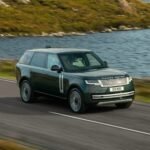

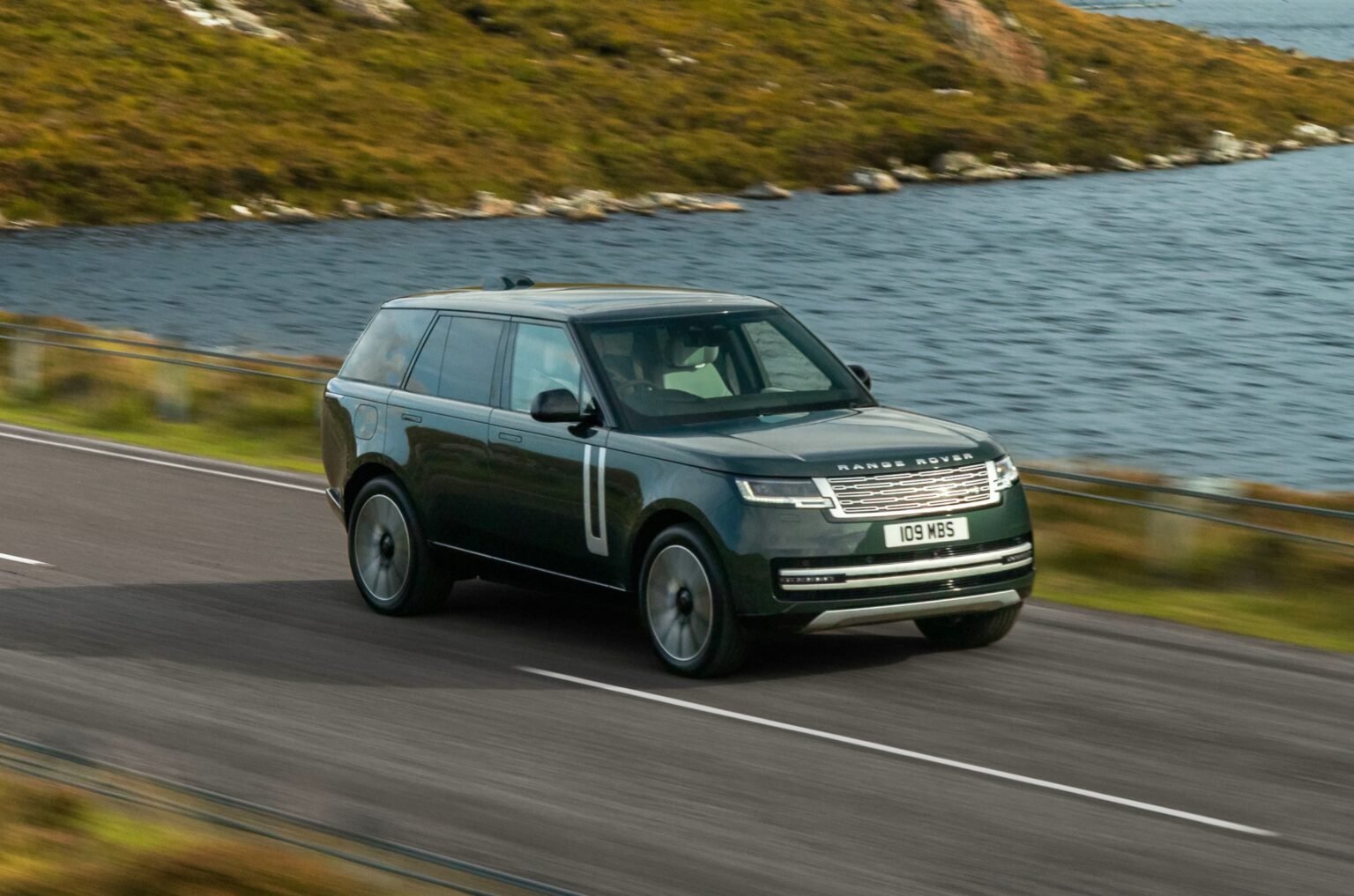
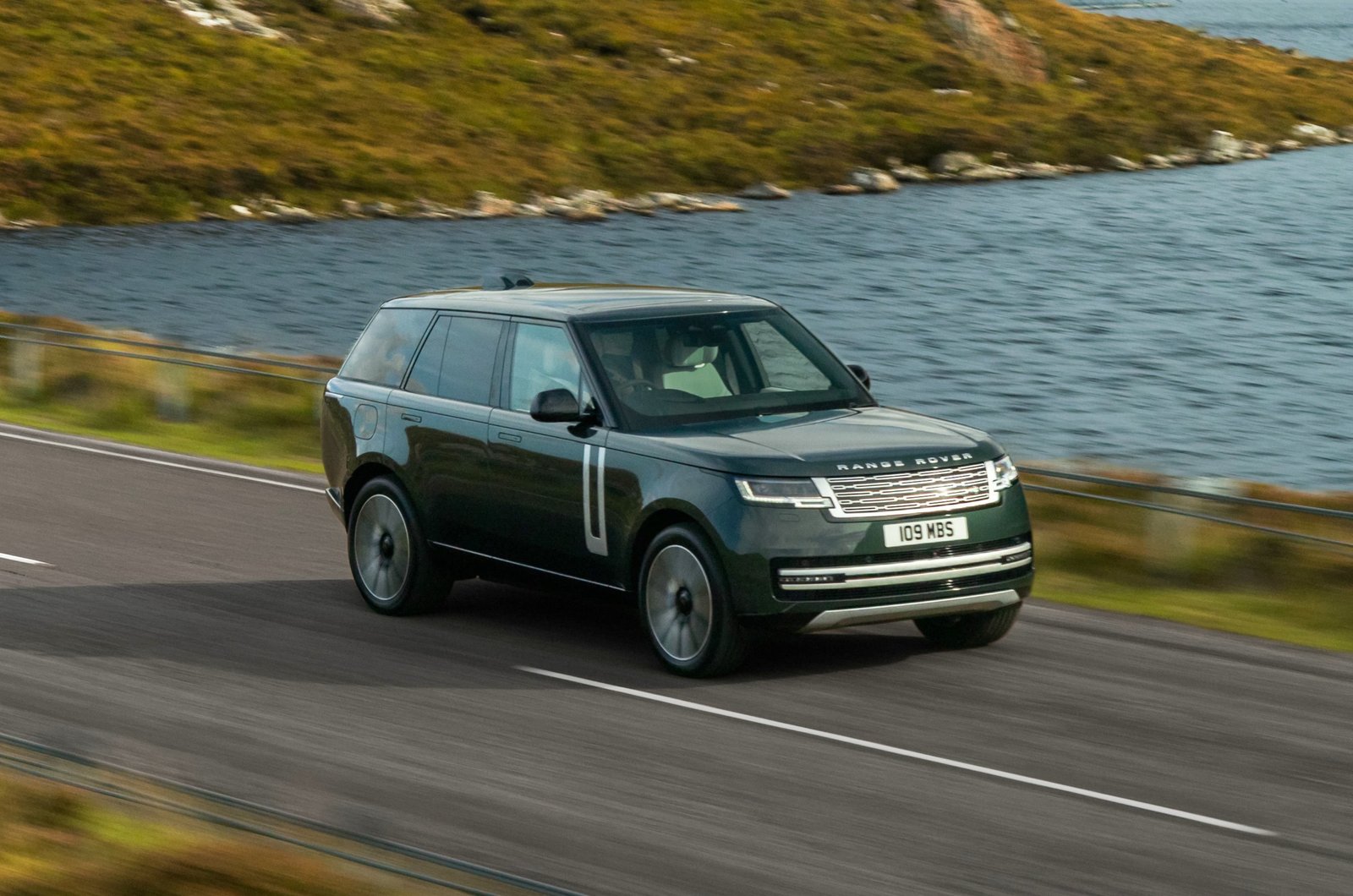
You’d never know this was the new electric Range Rover even if you stared a while. But that’s the whole point, says JLR, and I’m happy for it. Just because a car’s electric doesn’t mean it has to look like something else entirely, or grow a connected LED tail light or sprout a massive touchscreen. No, this the company says is a Range Rover first, and electric mobility simply another option in a lengthy powertrain choice; there’s petrol, diesel, hybrid and plug-ins too. The electric one however has been long time coming, so since it’s here now so let’s get straight to it.
Range Rover Electric Performance and Refinement – 10/10
Smoother, quicker and more capable off-road, it will ace rivals and its ICE siblings too.
Powering the Range Rover are two permanent magnet electric motors, one on each axle. They are specifically built for the brand as the company says none on the market could deliver the mix of performance, efficiency and character it needed. Combined they put out 550hp (there’s also a 450hp version) and a massive 850Nm of torque.
What’s truly impressive though is how well calibrated their power delivery is. There’s none of that instant dump and mad scramble, what you get is power dolled out in a quick but measured manner, so it moves smartly off the line and its plenty quick too, 0 to 100kph coming up in 4.5 seconds. Combined with a well calibrated throttle pedal there’s a character to it’s drive and it feels natural and quite ICE like, but with a smoothness you’d expect of an EV. It’s also very refined and quite as you would expect in an EV and there’s active noise cancellation working to remove a lot of road and wind noise. On the whole the electric powertrain only furthers the Range Rovers quiet and refined drive experience.
A Range Rover has excellent off-road chops, and here JLR has used the electric motive power to only further enhance these abilities. Scotland’s magnificent terrain had for us a long off-road trail through muddy mountains, loose pebbled beaches and rocky bedded streams and a loch too, no artificial prepared course here. To say the Range Rovers performance was brilliant would be an understatement. There’s no low range gear here, the instant torque that’s all available right from the first revolution in an electric motor is put to good use and the powertrain simply kept us motoring through everything the landscape threw without a fuss, progress was constant.
There was barely even wheelspin, most of it managed thanks to a super quick traction management system. With essentially only electrical and electronic components, power can be throttled back or increased at a specific wheel far quicker than in an internal combustion’s electro-mechanical system, a hundred times so says the company.
This is all controllable via multiple drive and terrain modes including a wading mode where depth stands at an identical 900mm on the EV and ICE versions. There’s the radar display too showing you just how deep you are at. We went about 400mm deep that day, but a few days earlier, rains meant the stream was just over 900mm and JLR says everyone got through that day too. Only a far more brutal course would challenge this SUV, and one that not many – or no owner would venture into.
Range Rover Electric Ride Comfort and Handling – 8/10
Pillow-soft ride with tidy body control and smooth stops.
We’ve come to expect EV’s to deliver better on ride and handling too and that’s indeed the case here. For starters there’s the lower center of gravity, with the weight of the battery below, the electric Range Rover has an 88mm lower CG than the ICE variants, standard ground clearance is about 18mm lower, though still impressive at 201mm and 262mm in off-road mode.
This lower CG means body roll is lower too and it does feel so. Through twisty roads in the Scottish Highlands body roll felt contained enough and handling was predictable and safe; it was only on a section with alternating dips that you felt a slight top sway.
Ride too was another highlight, there’s twin-valve dampers and twin-chamber air suspension which kept things nice and plush. It didn’t crash even on sharp ruts off-road and over a broken trail that we tackled rally style it simply held course and the ride was never crashy.
The single pedal driving mode has what JLR calls ‘chauffeur stop’ this brings the car to a halt with smooth and progressive braking and then gently releases the brakes raising the nose without the faintest jerk. There’s also a good feel from the brakes and you can’t really tell between motor and friction braking.
Range Rover Electric Battery, Charging, and Range – 7/10
Delivers sufficient range, though for where it’s capable of going, more would be better.
Powering the Range Rover Electric is a 118.5kWh NMC battery which uses double stacked cells, and before you think this will ruin ground clearance or seating posture, it does not. 800V electrical architecture accepts rapid charging up to 350kW and a 10 to 80 percent charge takes about 22 minutes.
Claimed range stands at 600km on the WLTP cycle and you could expect about 450 to 500kms in the real world. It does drop rapidly though when climbing hills and getting through slush so when venturing off-road make sure there’s a charger at your stop or enough battery juice to get you back.
Range Rover Electric Exterior Design and Engineering – 9/10
Identical to its ICE siblings the electric Range Rover boasts of a classy and timeless design.
The MLA (Modular Longitudinal Architecture) on which the SUV sits was announced back in 2018 and designed to support multiple propulsion sources and all importantly offering identical or very close structural dimensions in terms of seating height, ground clearance, cabin volume etc.
Interestingly and thankfully so, JRL has kept styling near identical too across all Range Rover powertrains, it may not appeal to those wishing to make a statement about owning an EV but JLR says its customers wanted their Range Rover exactly this approach. So, the entire look is virtually identical, up front you have the same bonnet adorned with the brands lettering, the same slim headlights that peel back at the top edge and even a very familiar grille which is only tweaked for aero-optimization.
At the side too there’s the same glass house, doors and the front fender with its distinctive vertical sash-like grille finish. The only clue to its electric drivetrain is ‘EV’ lettered on the wheel hubcaps. At the rear too you have the clean tailgate with the brand lettering across a black panel flanked by slim vertical taillights.
Range Rover Electric Interior Space and Comfort – 9/10
Acres of space especially so in LWB version with powered everything on offer.
Despite the battery below, comfort in the electric version remains good with easy ingress and egress – especially so with the automatic lowering of the body height – and a natural seating position too. With the MLA platform having being designed with electrification in mind, the battery below does not push your knees up nor as we’ve already seen, does it compromise ground clearance.
The electric Range Rover will be available in both the standard as well as long wheelbase versions and like the ICE siblings space inside is generous all around. Legroom in the standard wheelbase feels adequate and the front passenger seat does move forward and has the extendable leg rest too but taller passengers might find the need for a more expansive space, that’s where the long wheel base comes in which is truly expansive and comfy.
Seats of course are all powered too and outer ones feature heating, cooling and massage functions. There’s even JLR’s new body and soul seating, which uses seat and floor mat transducers to create audio vibrations for an immersive audio experience.
Range Rover Electric Features and Safety – 9/10
Powered everything including the center armrest and fridge door too.
Aside from a few EV specific displays, features are identical in the electric version of the Range Rover. Starting at the very rear there’s the powered split tailgate and the ‘event suite’ which is a fold out bench that transforms the boot into a handy perch and tailgate speakers and lights that can create a warm and inviting ambience. In freezing Scotland though we preferred to simply stay right inside and enjoyed heated seats with their ‘hot stone’ massage.
Signature suite versions also get you a center console with powered cupholders and a powered fold-out table too. Speaking of powered functions, pretty much everything is motorised including the rear fridge door and flipping down the central armrest in the non ‘suite’ cars. Controlling it all is via a central touchscreen and of course there’s rear entertainment screens for both rear passengers. The cabin has an air filter as well as CO2 monitoring to ensure fresh air inside, and in what is a first for a Range Rover there’s a cabin fragrance diffuser too. And don’t worry about features like 4-zone climate control and a panoramic sunroof, they’re all there.
Up front you have the waterfall-like 13.1-inch central touchscreen and a 13.7-inch instrument panel which thankfully hasn’t let go of if dial displays all in the interest of ‘being an EV’. There’s even the gear lever like drive selector and not button or a touch panel. All in all, it’s a very mature approach to the cabin design and the choice of materials, colours and finish is also top-notch.
Range Rover Electric Value for Money – 7/10
Will sit at the top of the range in price, and in comfort and ability too.
The electric Range Rover is near identical to its ICE siblings, not so in price though at least not in India. In 2024, JLR India began local assembly of ICE versions of the Range Rover which significantly brought down prices, at the time by up to Rs 44 lakh and the current range begins at Rs 2.4 crore ex-showroom. The electric versions however will come in as CBUs so besides their electric powertrain premium, there’s the additional tax and there’s no FTA benefit either.
Expect prices to start around the Rs 3 crore mark. It would be pricey then, but JLR says it wants to gauge customer interest first and then take a decision on local assembly. Ideally, it would seem like a good decision to begin with local production given the price benefit and the fact that the EV can also be assembled on the very same manufacturing line. All will be known in January next year though with deliveries set to commence towards the second half of 2027.
So should you get one? The electric Range Rover does sit at the top of the price range but then as we’ve seen it quite clearly sits above them in comfort and all-round capability too.
In cars like a Range Rover, the powertrain is far from being the cornerstone of the experience and so electric power suits well. But rather than simply letting electric power blend further into the background JLR has utilised it brilliantly bringing all the advantages of this propulsion to the fore and furthering the Range Rovers qualities. Its quieter, more refined, rides and handles better and then it’s even more capable off-road too. So, if you’re getting a Range Rover, this is the one to have.