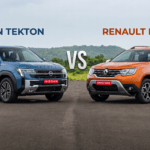




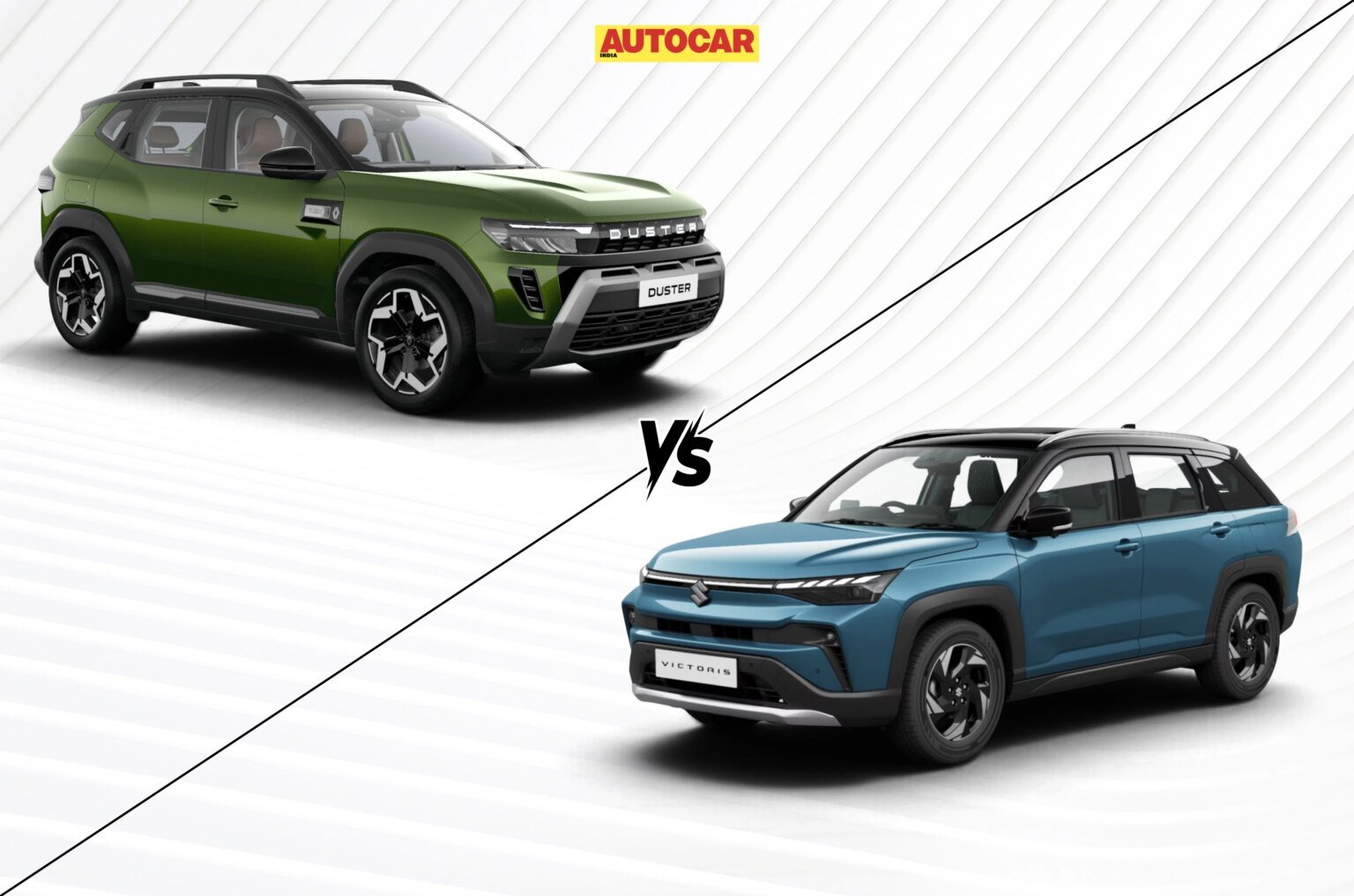
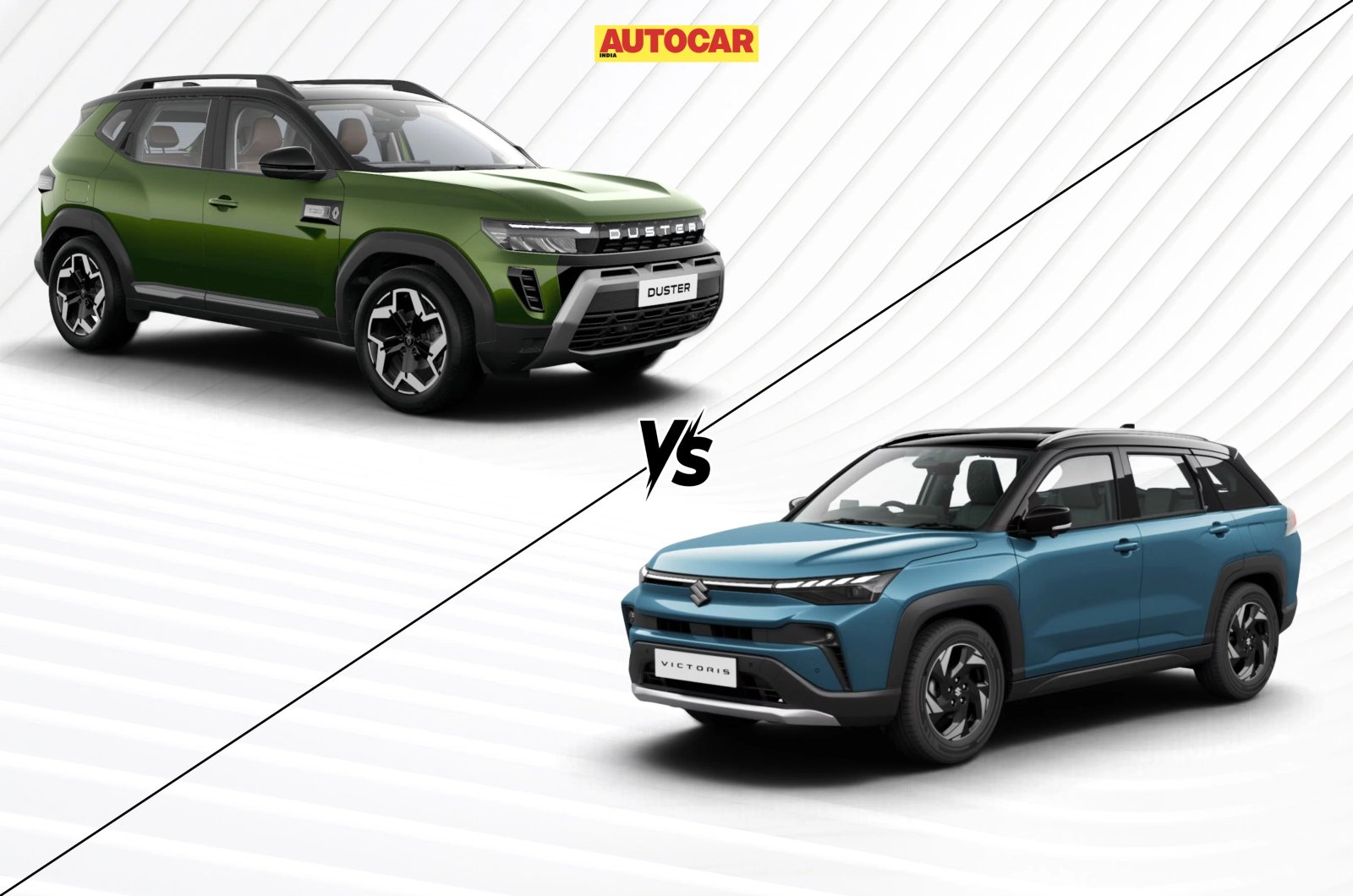
With the Duster strong-hybrid E-Tech 160, Renault is the latest brand to jump on the strong-hybrid bandwagon. The Duster strong-hybrid is positioned as an economical alternative powertrain and adds to its existing turbo-petrol options. On the other hand, the Maruti Victoris has been in the market for a year, offering a strong-hybrid powertrain since launch. But which strong-hybrid mid–size SUV in top-spec guise offers more bang for buck? We compare their respective on-paper specifications to find out. For this comparison, we’ve chosen the top-spec Emotion and ZXi+ (O) versions of the strong-hybrid Renault Duster and Maruti Victoris, respectively.
Renault Duster vs Maruti Victoris: Dimensions
Est. – Estimated
Apart from length, the Duster outranks the Victoris in every other dimension. It is 20mm wider, 39mm taller, has a 57mm longer wheelbase, and rides 2mm higher off the ground.
Renault Duster vs Maruti Victoris: Powertrain specifications
In strong-hybrid guise, both SUVs utilise a naturally aspirated petrol engine running on the more efficient Atkinson cycle. However, the Duster’s larger unit delivers more power and torque figures. The Duster also uses a larger battery pack. Both SUVs also use e-motors, wherein the one on the Maruti produces more power, but the Duster’s e-motor outputs more torque. With a combined power output of 160hp, the Duster strong-hybrid is much more powerful than the Victoris strong-hybrid.
Both SUVs also differ in the gearboxes utilised here. The Duster uses a multi-mode automatic gearbox with 2 electric and 4 petrol gears, whereas the Victoris uses an e-CVT. Renault says that the Duster drives 80 percent on EV power in the city, which likely contributes to its higher claimed mileage. But real-world tests are awaited for the Renault.
Renault Duster vs Maruti Victoris: Exterior features
On the outside, LED light setups, DRLs, roof rails, a shark fin antenna, and a powered tailgate are found on both SUVs. However, larger 18-inch alloy wheels, puddle lamps, and welcome/goodbye animations for the light setups are unique to the Duster.
Renault Duster vs Maruti Victoris: Interior features
The Renault offers features such as a powered co-driver seat and dual-zone automatic climate control that the Maruti lacks. In contrast, the latter gets further adjustment for the driver seat, two additional speakers, and on-board navigation, while features like a head-up display and ambient lighting are factory-fitted on the former.
Renault Duster vs Maruti Victoris: Driving features
As far as driving features are concerned, both models come with regular cruise control, but drive modes are found only on the Victoris.
Renault Duster vs Maruti Victoris: Safety features
On the safety front, both SUVs are well-equipped with features such as 6 airbags, rear parking sensors, auto-dimming IRVM, electronic parking brake with auto-hold, all-wheel disc brakes, and TPMS. However, the Victoris pips the Duster here by offering a 360-degree camera and front parking sensors. Notably, both miss out on a Level 2 ADAS suite.
Renault Duster vs Maruti Victoris: Prices and verdict
Comparing top-spec versions side by side, the Duster strong-hybrid is more affordable by Rs 41,000. Between the two, it’s the Duster we’d recommend. Apart from being the more affordable option, it offers slightly more kit and delivers more power without sacrificing much in terms of efficiency.