



Based on Hyundai’s ‘Art of Steel’ design philosophy, the new-gen Bayon has transformed significantly, with angular lines and a boxier profile
Hyundai has unveiled the 2nd-gen Bayon for European markets at the Paris Motor Show. The SUV gets major upgrades across the board. Hyundai has also showcased second-gen Bayon’s N Line version.
Bayon is coming to India as well, with launch scheduled for 26th October. European and Indian versions are not exactly the same.
Euro-spec 2nd-gen Bayon – Design, dimensions
Hyundai’s ‘Art of Steel’ design language dictates a sharper, more athletic build with futuristic vibes, something that is evident in the new Bayon.
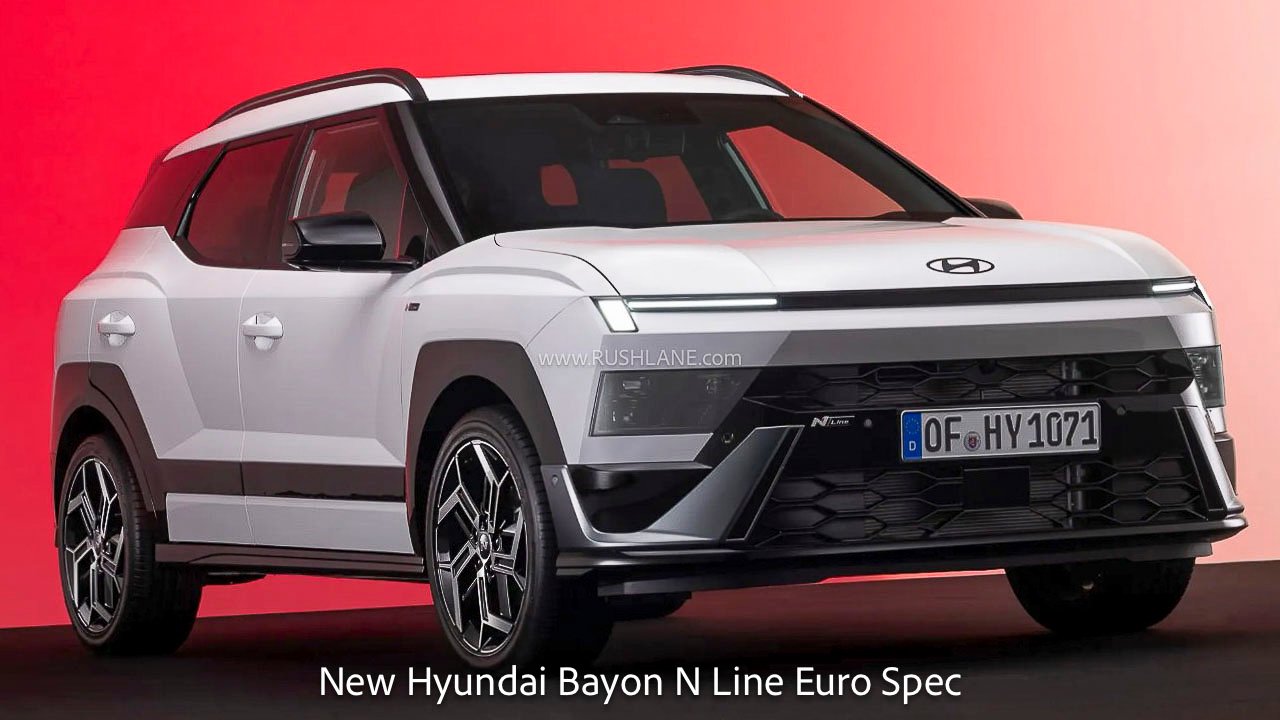
Key highlights include top-mounted H-style LED DRLs, trapezoidal enclosures for the headlamps and a prominent bonnet with mesh-pattern inserts. Side profile has squared wheel arches, door side moulding, conventional body coloured door handles, and blacked-out ORVMs and pillars.
Bayon N Line model gets a distinctive mesh grille pattern, high-gloss black cladding, bespoke lower-bumper winglets, sporty rear diffuser and dual exhausts. Another USP is 18-inch N Line alloy wheels. Interiors of Bayon N Line offer a more premium experience with cloth and suede sport seats and contrast red accents and red stitching. The steering wheel has exclusive N Line badging.
Euro-spec 2nd-gen Bayon has grown in size, measuring 4,245 mm long and 1,810 mm wide. That’s a gain of 65 mm in length and 35 mm in width. New Bayon has a wheelbase of 2,600 mm. Ground clearance will vary, depending on the variant and tyre size. Dimensional specs for the India-spec Bayon are yet to be revealed. However, it is expected to be closer to the Euro-spec version.
Cabin experience
Inside, the new Bayon in Europe gets dual 12.3-inch screens with a curved panoramic layout. The centre console has long, vertically stacked AC vents, which add a retro flavour to the largely futuristic cabin.
A number of physical buttons have been provided for added practicality. Bayon’s tech package comprises features like wireless Android Auto and Apple CarPlay and wireless phone charging.
Users also have the option to use their smartphone or smartwatch as a digital key. New Bayon has seats with ventilation and heating, USB-C ports, rear seat recline function, a panoramic sunroof and an eight speaker Bose audio system.
Boot space varies based on the powertrain, with the ICE version offering 440 litres. Hybrid versions will have a relatively smaller 397-litre boot.
Bayon to get full hybrid
Euro-spec new Bayon will be available initially with a 1.0-litre turbo petrol engine, generating either 90 hp or 115 hp. Transmission options include a 6-speed manual and a 7-speed dual clutch automatic. Variants with the higher-tuned engine have a top speed of 180 km/h.
In terms of powertrain options, the biggest update for the new Bayon will be a new full hybrid setup. This will be offered at a later date, working as a replacement for the mild-hybrid system used with the outgoing model.
The full hybrid powertrain will use a 1.6-litre petrol engine in combination with an electric motor. This setup will be paired with a 6-speed dual clutch automatic transmission. Combined output is 136 hp.
In India, Hyundai Bayon will be using a four-cylinder 1.5L MPi petrol engine, generating 115 PS and 144 Nm of torque. It will be paired with either a 6-speed manual or an Intelligent Variable Transmission (IVT). Other key highlights of India-spec Bayon include AI voice assistant (Perplexity + SoundHound AI), NVIDIA-powered Connected Car Navigation Cockpit (ccNC), multi-language support and seamless OTA updates.